PRECAUTIONS
1. When handling refrigerant (R-12), the following precautions should be observed:
(a) Always wear eye protection.
(b) Keep the refrigerant container (service drum) below 40°C (104°F).
(c) Do not handle refrigerant in an enclosed area where there is an open flame.
(d) Discharge refrigerant slowly when purging the system.
(e) Be careful that the liquid refrigerant does not get on your skin.
2. If liquid refrigerant gets in the eyes or on the skin:
(a) Do not rub the eye or skin.
(b) Wash the area with a lot of cool water.
(c) Apply clean petroleum jelly to the skin.
(d) Rush to a physician or hospital for immediate professional treatment.
(e) Do not attempt to treat yourself.
3. When tubing:
(a) Apply a few drops of compressor oil to the seats of the O-ring fittings.
(b) Tighten the nut using two wrenches to avoid twisting the tube.
(c) Tighten the O-ring fitting to the specified torque.
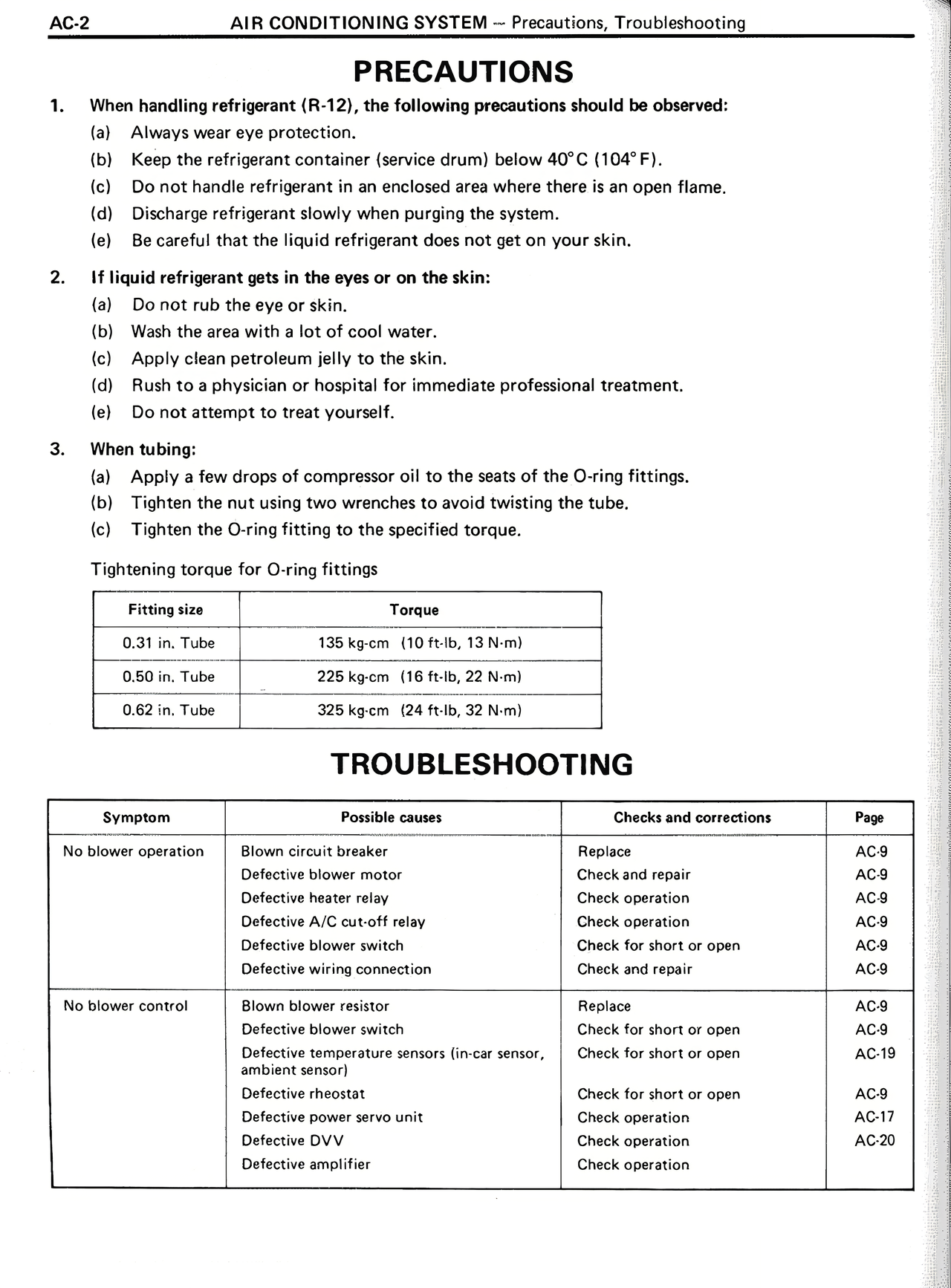
Tightening torque for O-ring fittings
Fitting size Torque
0.31 in. Tube 135 kg-cm (10 ft-lb, 13 N-m)
0.50 in. Tube 225 kg-cm (16 ft-lb, 22 N-m)
0.62 in. Tube 325 kg-cm (24 ft-lb, 32 N-m)
TROUBLESHOOTING
Symptom Possible causes Checks and corrections Page
No blower operation Blown circuit breaker Replace AC-9
Defective blower motor Check and repair AC-9
Defective heater relay Check operation AC-9
Defective A/C cut-off relay Check operation AC-9
Defective blower switch Check for short or open AC-9
Defective wiring connection Check and repair AC-9
No blower control Blown blower resistor Replace AC-9
Defective blower switch Check for short or open AC-9
Defective temperature sensors (in-car sensor, Check for short or open AC-19
ambient sensor)
Defective rheostat Check for short or open AC-9
Defective power servo unit Check operation AC-17
Defective DVV Check operation AC-20
Defective amplifier Check operation