TROUBLESHOOTING
GENERAL NOTES
1. Troubles occuring with the ECT can be caused by either the engine, ECT electrical control or the automatic transmission itself. These three areas should be distinctly isolated before proceeding with troubleshooting.
2. Troubleshooting should begin with the simplest operation, working up in order of difficulty, but initially determine whether the trouble lies within the engine, electrical control or transmission.
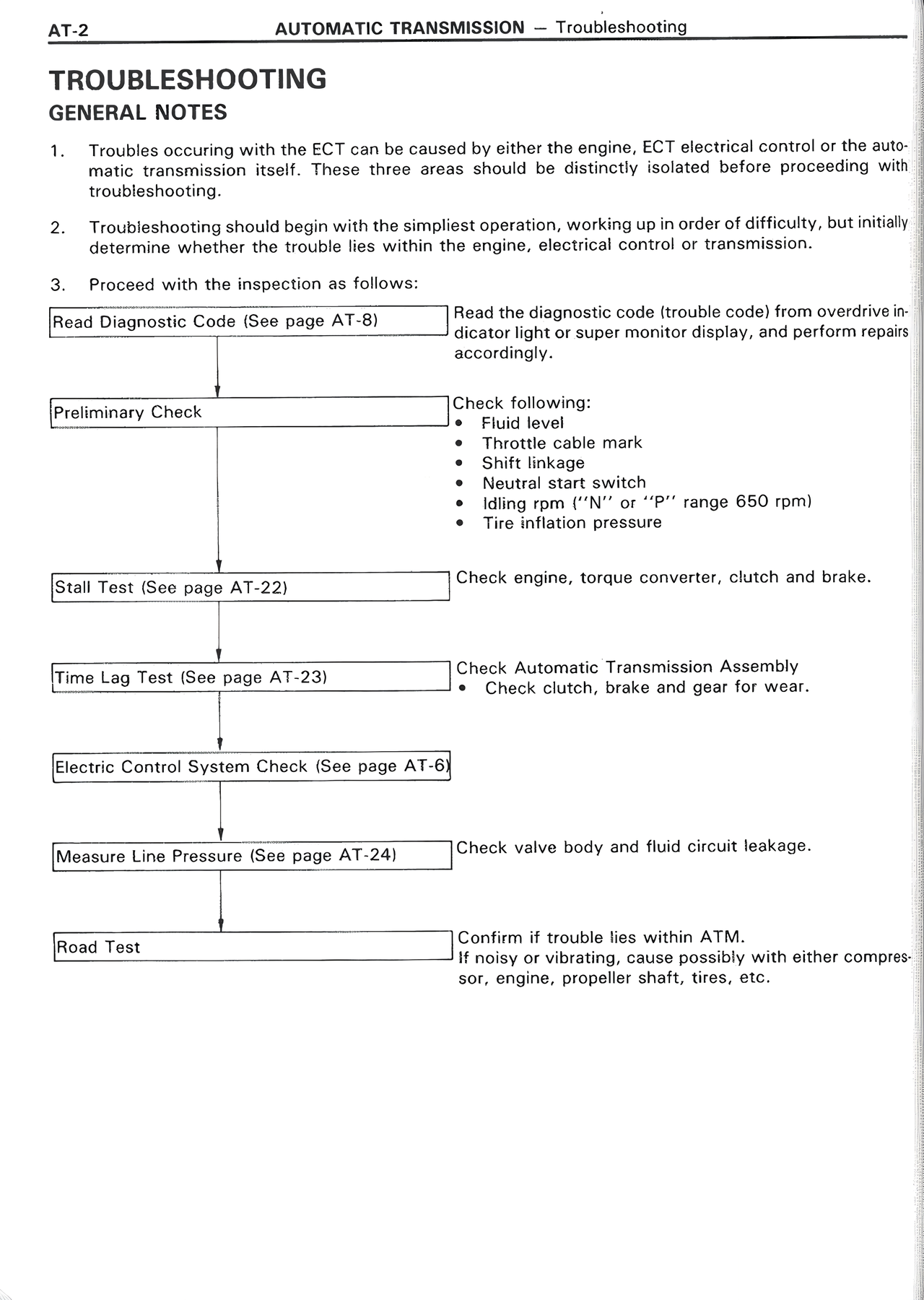
3. Proceed with the inspection as follows:
Read Diagnostic Code (See page AT-8)
Read the diagnostic code (trouble code) from overdrive indicator light or super monitor display, and perform repairs accordingly.
Preliminary Check
Check following:
• Fluid level
• Throttle cable mark
• Shift linkage
• Neutral start switch
• Idling rpm ("N" or "P" range 650 rpm)
• Tire inflation pressure
Stall Test (See page AT-22)
Check engine, torque converter, clutch and brake.
Time Lag Test (See page AT-23)
Check Automatic Transmission Assembly
• Check clutch, brake and gear for wear.
Electric Control System Check (See page AT-6)
Measure Line Pressure (See page AT-24)
Check valve body and fluid circuit leakage.
Road Test
Confirm if trouble lies within ATM.
If noisy or vibrating, cause possibly with either compressor, engine, propeller shaft, tires, etc.