TROUBLESHOOTING OF ELECTRICAL CONTROL CIRCUIT
Description
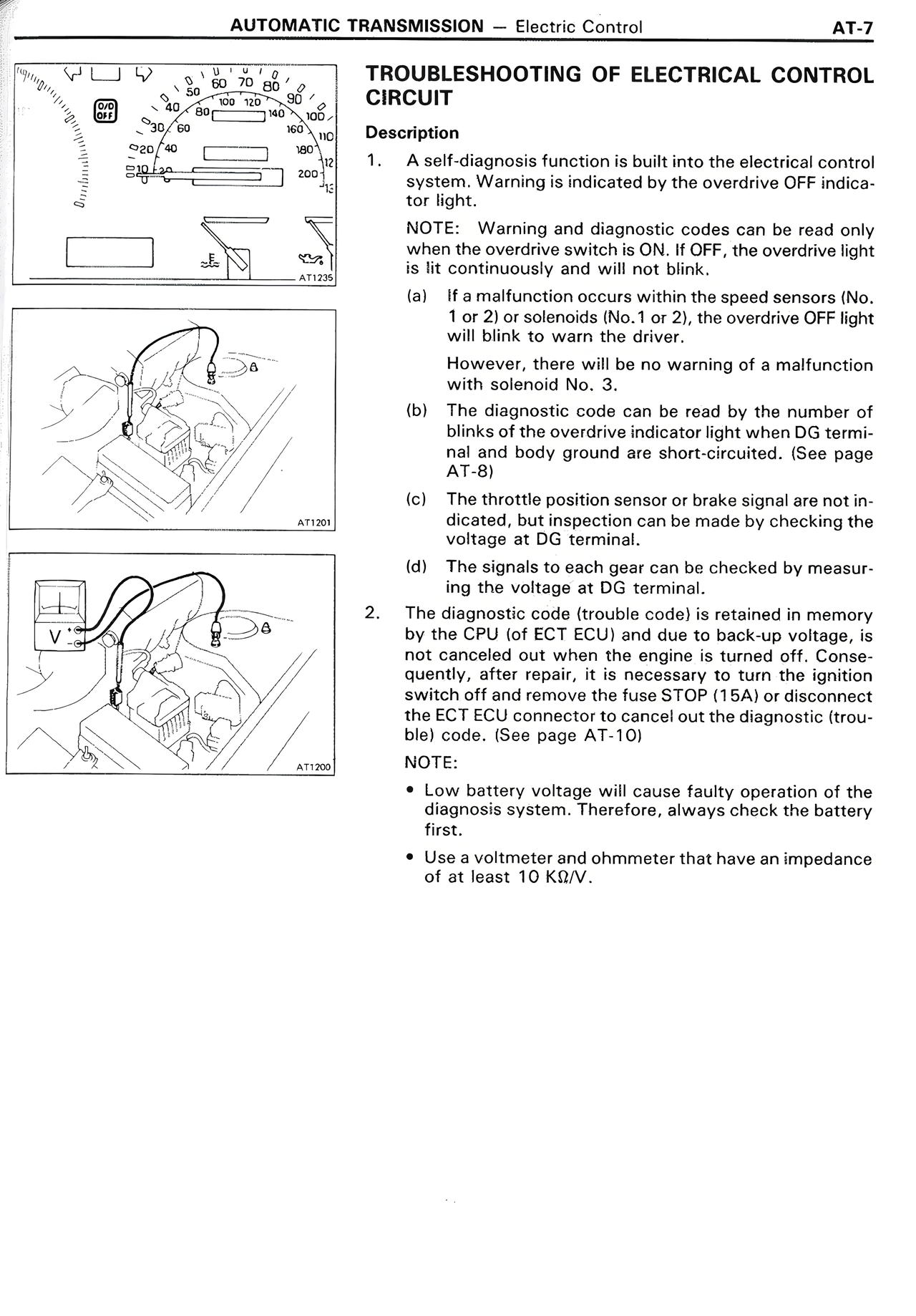
1. A self-diagnosis function is built into the electrical control system. Warning is indicated by the overdrive OFF indicator light.
NOTE: Warning and diagnostic codes can be read only when the overdrive switch is ON. If OFF, the overdrive light is continuously and will not blink.
(a) If a malfunction occurs within the speed sensors (No. 1 or 2 solenoids (No.1 or 2), the overdrive OFF light will blink to warn the driver.
However, there will be no warning of a malfunction with solenoid No. 3.
(b) The diagnostic code can be read by the number of blinks of the overdrive indicator light when DG terminal and body ground are short-circuited. (See page AT-8)
(c) The throttle position sensor or brake signal are not indicated, but inspection can be made by checking the voltage at DG terminal.
(d) The signals to each gear can be checked by measuring the voltage at D5 terminal.
2. The diagnostic code (trouble code) is retained in memory by the CPU (of ECT ECU) and due to back-up voltage, is not canceled out when the engine is turned off. Consequently, after repair, it is necessary to turn the ignition switch off and remove the fuse STOP (15A) or disconnect the ECT ECU connector to cancel out the diagnostic (trouble) code. (See page AT-10)
NOTE:
• Low battery voltage will cause faulty operation of the diagnosis system. Therefore, always check the battery first.
• Use a voltmeter and ohmmeter that have an impedance of at least 10 KΩ/V.