Outline of ECT
The conventional automatic transmission operates by mechanically converting vehicle speed into governor pressure, and throttle opening into throttle pressure, and using these hydraulic pressures to control the operation of the clutches and brakes in the planetary gear unit; thus controlling the timing of up-shift and down-shift of the transmission. This is called the "hydraulic control method."
In the case of the ECT, on the other hand, sensors electronically sense the speed of the vehicle and the amount the accelerator pedal is depressed, and send this information to the electronic control unit (hereafter called ECU) in the form of electrical signals. The ECU then controls the operation of the clutches and brakes based on these data, thus controlling the timing of the shift points.
SHIFT CONTROL
• Hydraulic Controlled Transmission
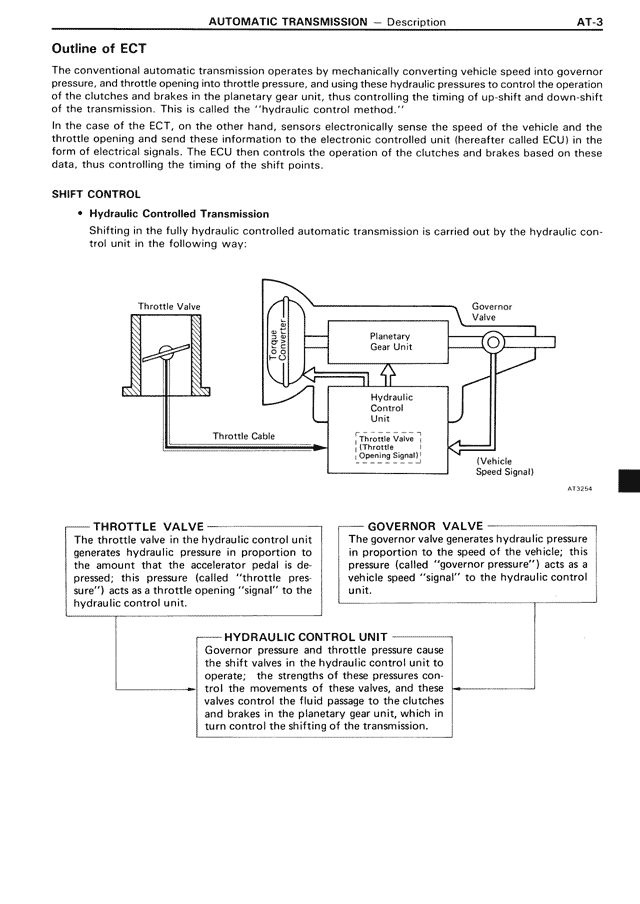
Shifting in the fully hydraulic controlled automatic transmission is carried out by the hydraulic control unit in the following way:
[DIAGRAM showing Throttle Valve, Torque Converter, Planetary Gear Unit, Governor Valve, Hydraulic Control Unit with Throttle Valve (Throttle Opening Signal), Throttle Cable, and Vehicle Speed Signal connections]
THROTTLE VALVE
The throttle valve in the hydraulic control unit generates hydraulic pressure in proportion to the amount that the accelerator pedal is depressed; this pressure (called "throttle pressure") acts as a throttle opening "signal" to the hydraulic control unit.
GOVERNOR VALVE
The governor valve generates hydraulic pressure in proportion to the speed of the vehicle; this pressure (called "governor pressure") acts as a vehicle speed "signal" to the hydraulic control unit.
HYDRAULIC CONTROL UNIT
Governor pressure and throttle pressure cause the shift valves in the hydraulic control unit to operate; the strengths of these pressures control the movements of these valves, and these valves control the fluid passage to the clutches and brakes in the planetary gear unit, which in turn control the shifting of the transmission.