← p.006p.008 →
EGE/Emission System 2JZ-GE — Exhaust Gas Recirculation (EGR) System EGR System Inspection, page 7
7 / 13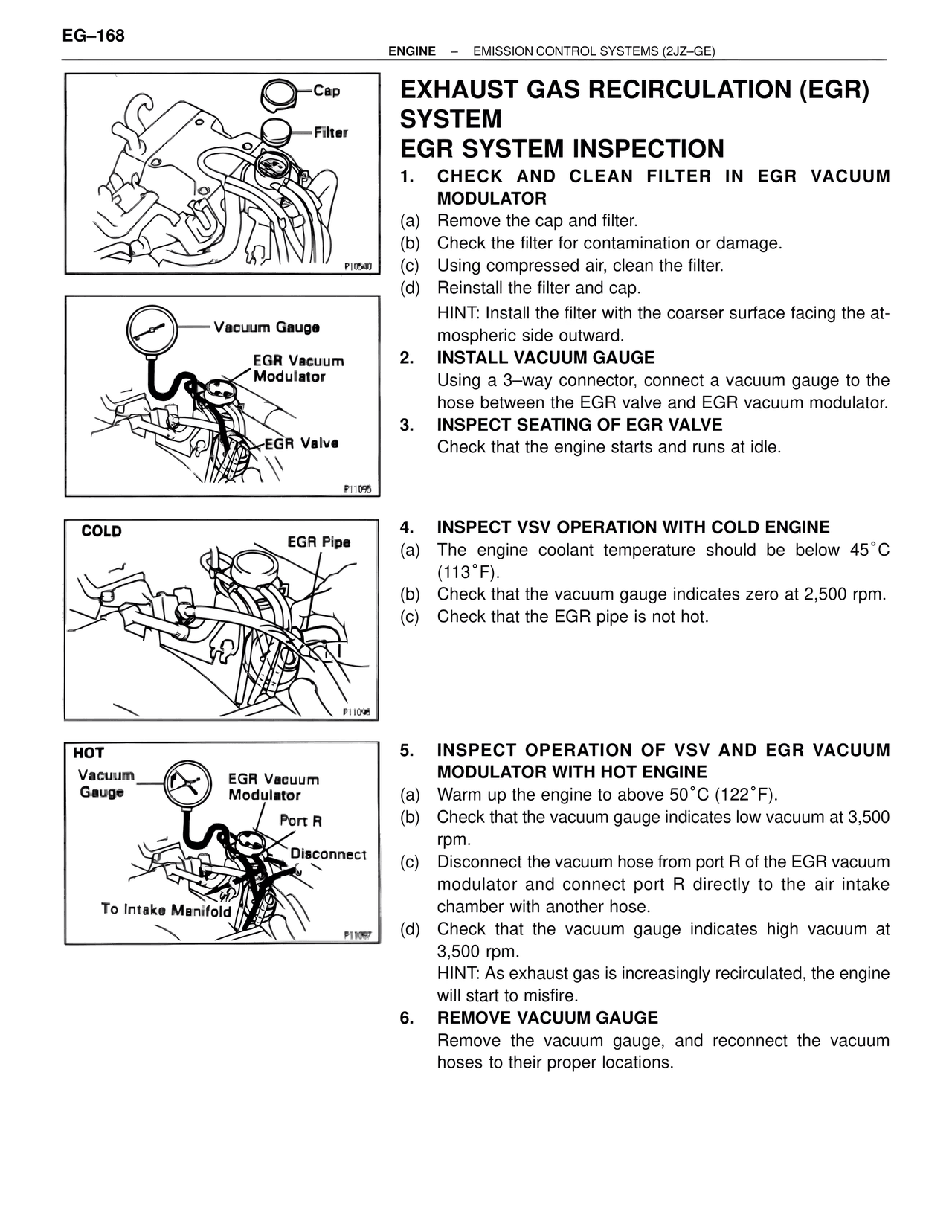
100%
Page text (OCR transcript)
EG–168
ENGINE – EMISSION CONTROL SYSTEMS (2JZ–GE)

Cap
Filter
P10540

Vacuum Gauge
EGR Vacuum
Modulator
EGR Valve
P11095

COLD
EGR Pipe
P11096

HOT
Vacuum
Gauge
EGR Vacuum
Modulator
Port R
Disconnect
To Intake Manifold
P11097

EXHAUST GAS RECIRCULATION (EGR)
SYSTEM
EGR SYSTEM INSPECTION

1. CHECK AND CLEAN FILTER IN EGR VACUUM
MODULATOR
(a) Remove the cap and filter.
(b) Check the filter for contamination or damage.
(c) Using compressed air, clean the filter.
(d) Reinstall the filter and cap.
HINT: Install the filter with the coarser surface facing the at-
mospheric side outward.

2. INSTALL VACUUM GAUGE
Using a 3–way connector, connect a vacuum gauge to the
hose between the EGR valve and EGR vacuum modulator.

3. INSPECT SEATING OF EGR VALVE
Check that the engine starts and runs at idle.

4. INSPECT VSV OPERATION WITH COLD ENGINE
(a) The engine coolant temperature should be below 45°C
(113°F).
(b) Check that the vacuum gauge indicates zero at 2,500 rpm.
(c) Check that the EGR pipe is not hot.

5. INSPECT OPERATION OF VSV AND EGR VACUUM
MODULATOR WITH HOT ENGINE
(a) Warm up the engine to above 50°C (122°F).
(b) Check that the vacuum gauge indicates low vacuum at 3,500
rpm.
(c) Disconnect the vacuum hose from port R of the EGR vacuum
modulator and connect port R directly to the air intake
chamber with another hose.
(d) Check that the vacuum gauge indicates high vacuum at
3,500 rpm.
HINT: As exhaust gas is increasingly recirculated, the engine
will start to misfire.

6. REMOVE VACUUM GAUGE
Remove the vacuum gauge, and reconnect the vacuum
hoses to their proper locations.