AIR CONDITIONING SYSTEM — Refrigeration System AC-13
[DIAGRAM: Handle, Connection, Disc labeled diagram AQ160]
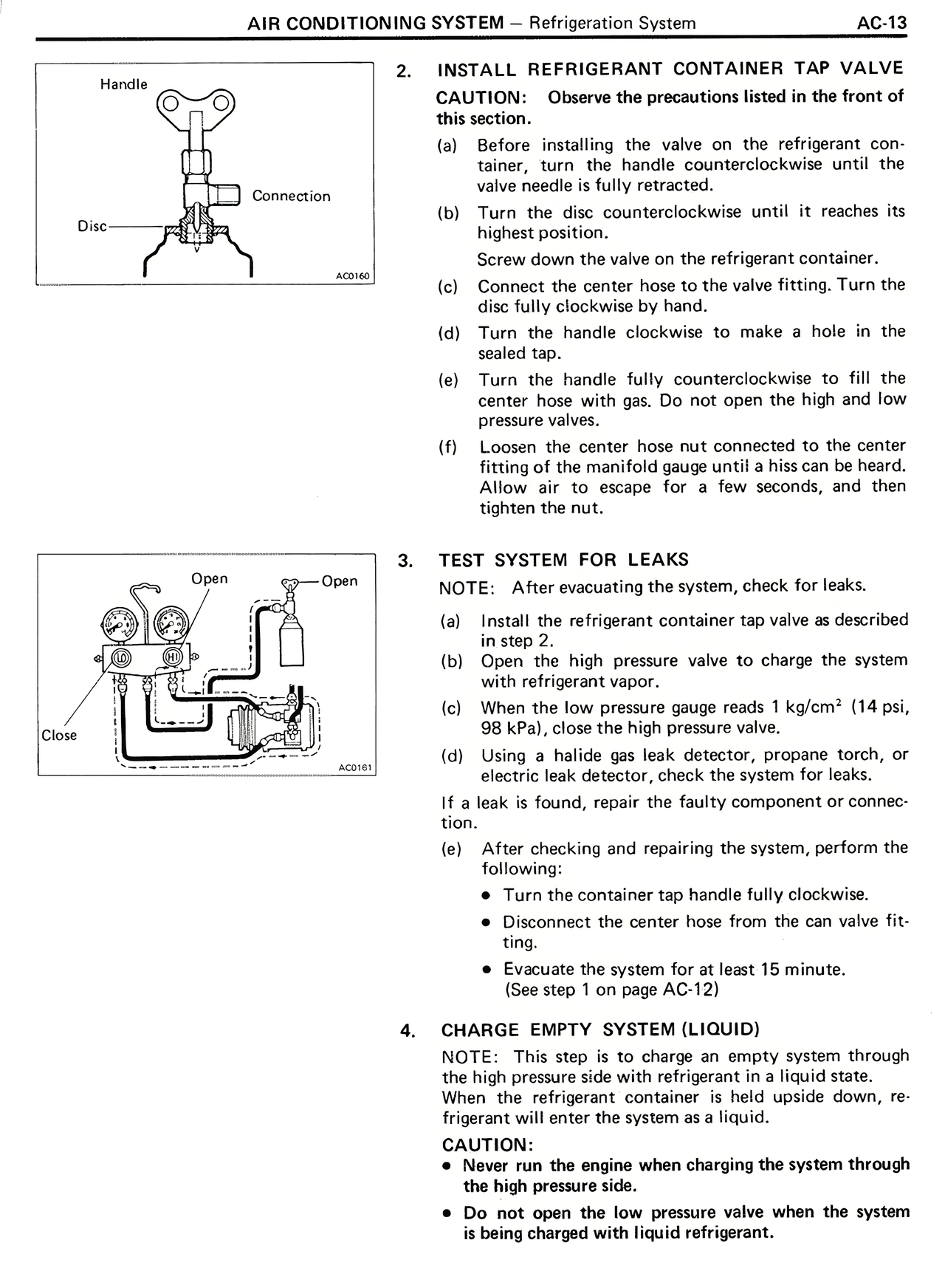
2. INSTALL REFRIGERANT CONTAINER TAP VALVE
CAUTION: Observe the precautions listed in the front of this section.
(a) Before installing the valve on the refrigerant container, turn the handle counterclockwise until the valve needle is fully retracted.
(b) Turn the disc counterclockwise until it reaches its highest position.
Screw down the valve on the refrigerant container.
(c) Connect the center hose to the valve fitting. Turn the disc fully clockwise by hand.
(d) Turn the handle clockwise to make a hole in the sealed tap.
(e) Turn the handle fully counterclockwise to fill the center hose with gas. Do not open the high and low pressure valves.
(f) Loosen the center hose nut connected to the center fitting of the manifold gauge until a hiss can be heard. Allow air to escape for a few seconds, and then tighten the nut.
3. TEST SYSTEM FOR LEAKS
NOTE: After evacuating the system, check for leaks.
(a) Install the refrigerant container tap valve as described in step 2.
(b) Open the high pressure valve to charge the system with refrigerant vapor.
(c) When the low pressure gauge reads 1 kg/cm² (14 psi, 98 kPa), close the high pressure valve.
(d) Using a halide gas leak detector, propane torch, or electric leak detector, check the system for leaks.
If a leak is found, repair the faulty component or connection.
(e) After checking and repairing the system, perform the following:
• Turn the container tap handle fully clockwise.
• Disconnect the center hose from the can valve fitting.
• Evacuate the system for at least 15 minute. (See step 1 on page AC-12)
[DIAGRAM: System diagram showing Open/Close valves, gauges, and connections labeled AQ161]
4. CHARGE EMPTY SYSTEM (LIQUID)
NOTE: This step is to charge an empty system through the high pressure side with refrigerant in a liquid state. When the refrigerant container is held upside down, refrigerant will enter the system as a liquid.
CAUTION:
• Never run the engine when charging the system through the high pressure side.
• Do not open the low pressure valve when the system is being charged with liquid refrigerant.