PRECAUTIONS
1. Check that the battery cables are connected to the correct terminals.
2. Disconnect the battery cables when the battery is given a quick charge.
3. Do not perform tests with a high voltage insulation resistance tester.
4. Never disconnect the battery when the engine is running.
TROUBLESHOOTING
Problem | Possible cause | Remedy | Page
Discharge warning light does not light with ignition ON and engine off | Fuse blown | Check "CHARGE" and "IGN" fuses |
Light burned out | Replace light |
Wiring connection loose | Tighten loose connections |
IC regulator faulty | Replace IC regulator | CH-6
Discharge warning light does not go out with engine running (battery requires frequent recharging) | Drive belt loose or worn | Adjust or replace drive belt | CH-3
Battery cables loose, corroded or worn | Repair or replace cables |
Fuse blown | Check "ENGINE" fuse |
Fusible link blown | Replace fusible link |
IC regulator or alternator faulty | Check charging system | CH-4
Wiring faulty | Repair wiring |
ON-VEHICLE INSPECTION
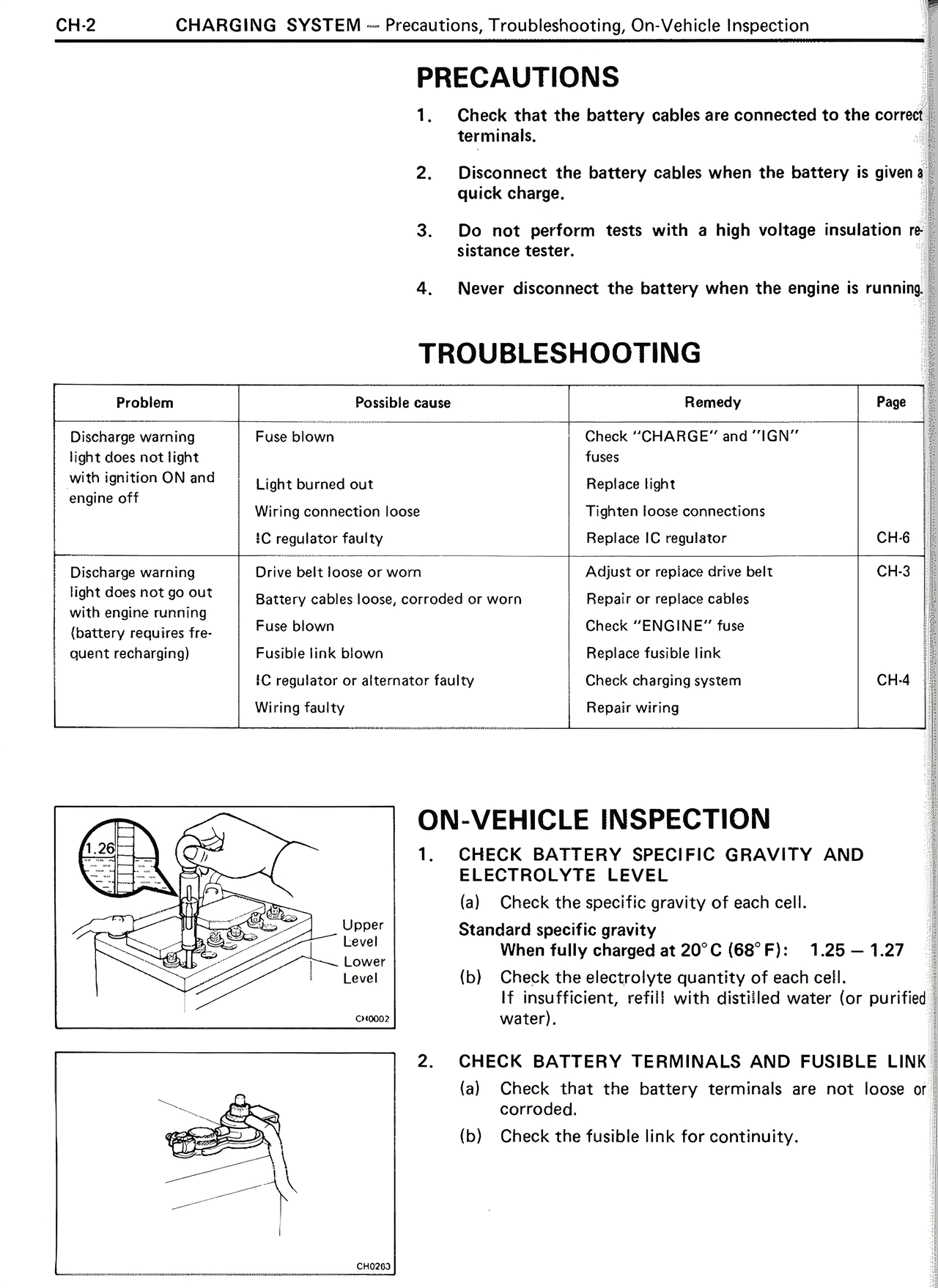
1. CHECK BATTERY SPECIFIC GRAVITY AND ELECTROLYTE LEVEL
(a) Check the specific gravity of each cell.
Standard specific gravity
When fully charged at 20°C (68°F): 1.25 — 1.27
(b) Check the electrolyte quantity of each cell.
If insufficient, refill with distilled water (or purified water).
2. CHECK BATTERY TERMINALS AND FUSIBLE LINK
(a) Check that the battery terminals are not loose or corroded.
(b) Check the fusible link for continuity.