Page text (OCR transcript)
COMPRESSION CHECK

NOTE: If there is lack of power, excessive oil consumption or poor fuel mileage, measure the cylinder compression pressure.

1. WARM UP ENGINE

2. REMOVE SPARK PLUGS

3. DISCONNECT HIGH-TENSION CORD FROM DISTRIBUTOR

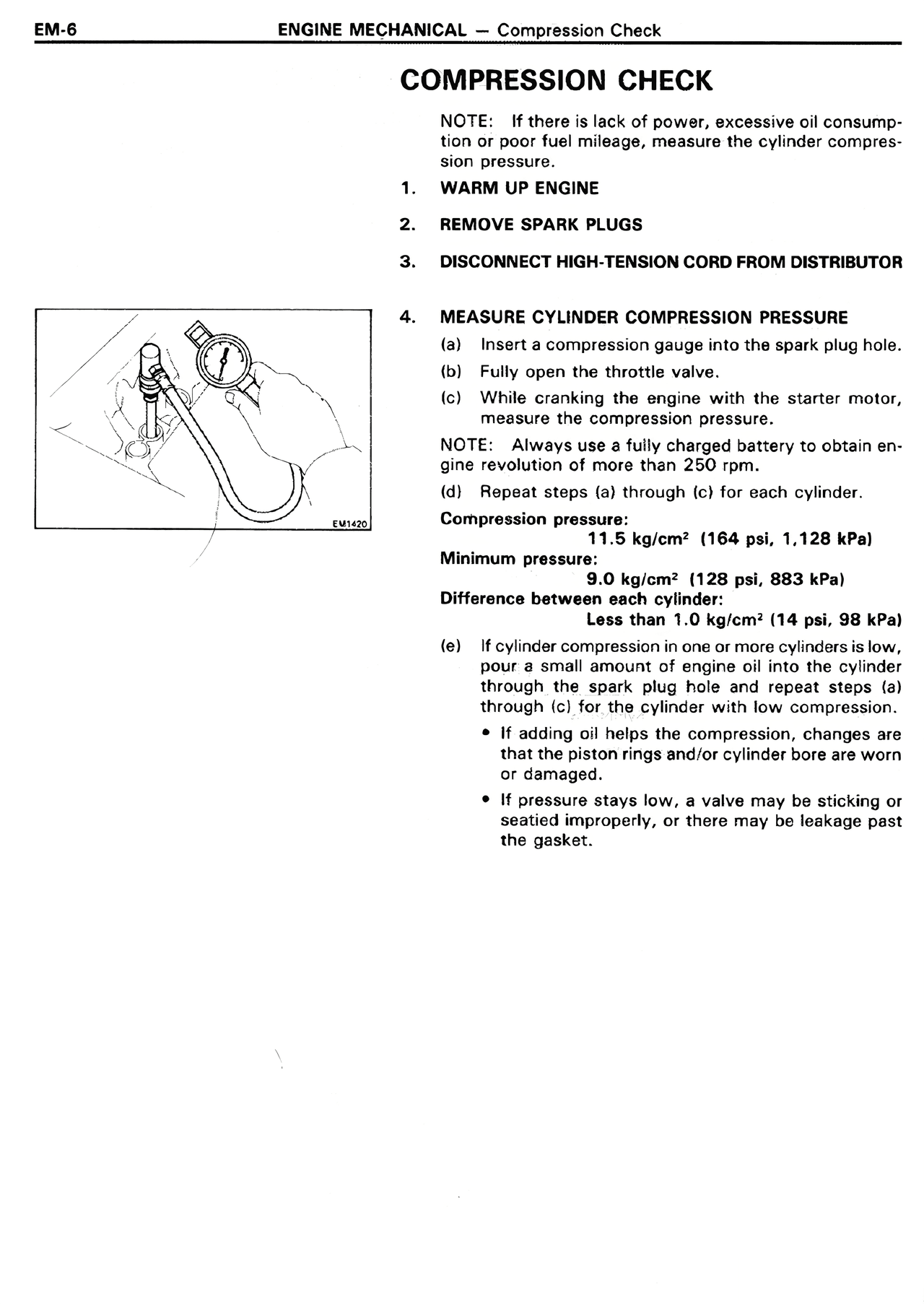
4. MEASURE CYLINDER COMPRESSION PRESSURE
(a) Insert a compression gauge into the spark plug hole.
(b) Fully open the throttle valve.
(c) While cranking the engine with the starter motor, measure the compression pressure.

NOTE: Always use a fully charged battery to obtain engine revolution of more than 250 rpm.

(d) Repeat steps (a) through (c) for each cylinder.

Compression pressure:
11.5 kg/cm² (164 psi, 1,128 kPa)
or
9.0 kg/cm² (128 psi, 883 kPa)
Difference between each cylinder:
Less than 1.0 kg/cm² (14 psi, 98 kPa)

(e) If cylinder compression in one or more cylinders is low, pour a small amount of engine oil into the cylinder through the spark plug hole and repeat steps (a) through (c) for the cylinder with low compression.

• If adding oil helps the compression, changes are that the piston rings and/or cylinder bore are worn or damaged.

• If pressure stays low, a valve may be sticking or seated improperly, or there may be leakage past the gasket.