AIR CONDITIONING SYSTEM — General Information AC-3
[Image: Charging Valve with Plug labeled AC1604]
[Image: Below 40°C storage diagram showing Wrong and Correct positions, labeled AC1608]
[Image: A/C ON diagram showing car with refrigerant cycle, labeled AC1609]
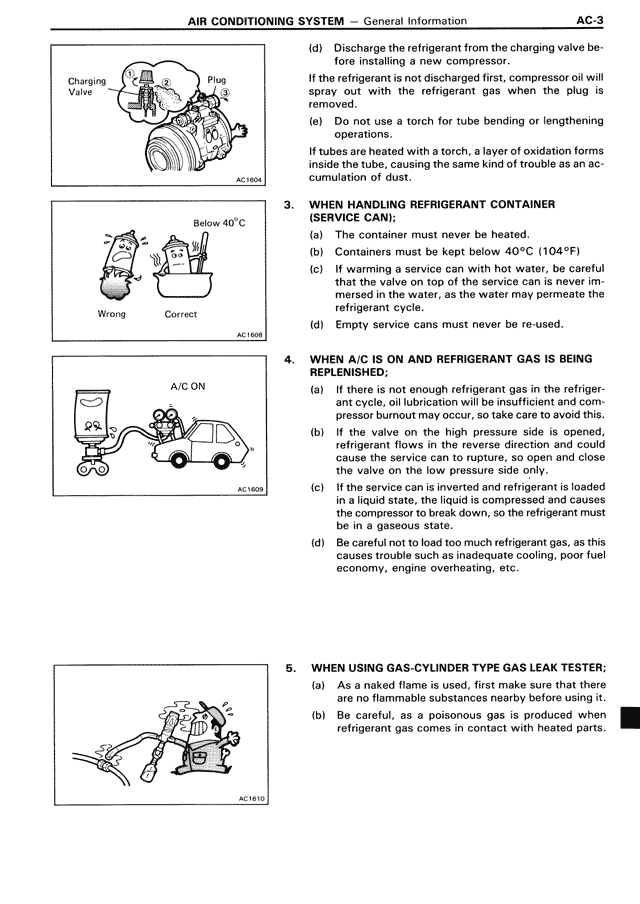
(d) Discharge the refrigerant from the charging valve before installing a new compressor.
If the refrigerant is not discharged first, compressor oil will spray out with the refrigerant gas when the plug is removed.
(e) Do not use a torch for tube bending or lengthening operations.
If tubes are heated with a torch, a layer of oxidation forms inside the tube, causing the same kind of trouble as an accumulation of dust.
3. WHEN HANDLING REFRIGERANT CONTAINER (SERVICE CAN):
(a) The container must never be heated.
(b) Containers must be kept below 40°C (104°F)
(c) If warming a service can with hot water, be careful that the valve on top of the service can is never immersed in the water, as the water may permeate the refrigerant cycle.
(d) Empty service cans must never be re-used.
4. WHEN A/C IS ON AND REFRIGERANT GAS IS BEING REPLENISHED:
(a) If the compressor does not operate in the refrigerant cycle, oil lubrication will be insufficient and compressor burnout may occur, so take care to avoid this.
(b) If the valve on the high pressure side is opened, refrigerant flows in the reverse direction and could cause the service can to rupture, so open and close the valve on the low pressure side only.
(c) If the service can is inverted and refrigerant is loaded in a liquid state, the liquid is compressed and causes the compressor to break down, so the refrigerant must be in a gaseous state.
(d) Be careful not to load too much refrigerant gas, as this causes trouble such as inadequate cooling, poor fuel economy, engine overheating, etc.
[Image: Gas leak testing diagram labeled AC1610]
5. WHEN USING GAS-CYLINDER TYPE GAS LEAK TESTER:
(a) As a naked flame is used, first make sure that there are no flammable substances nearby before using it.
(b) Be careful, as a poisonous gas is produced when refrigerant gas comes in contact with heated parts.