AUTOMATIC TRANSMISSION — Troubleshooting (Mechanical System Tests) AT-33
(d) If the stall speed in R range is higher than specified without the rear wheels rotating:
• Line pressure too low
• Direct clutch slipping
• First and reverse brake slipping
• O/D one-way clutch not operating properly
(e) If the stall speed in both R and D ranges are higher than specified without the rear wheels rotating:
• Line pressure too low
• Improper fluid level
• O/D one-way clutch not operating properly
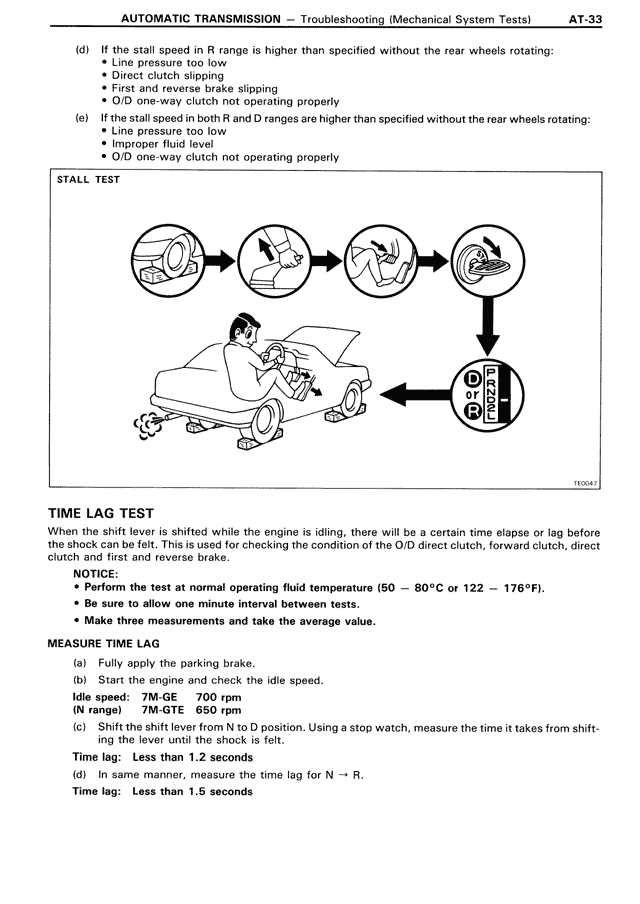
STALL TEST
[THIS IS FIGURE: A series of 5 circular diagrams showing stall test procedure, including gauges and a car on blocks, connected by arrows, labeled TEC047]
TIME LAG TEST
When the shift lever is shifted while the engine is idling, there will be a certain time elapse or lag before the shock can be felt. This is used for checking the condition of the O/D direct clutch, forward clutch, direct clutch and first and reverse brake.
NOTICE:
• Perform the test at normal operating fluid temperature (50 — 80°C or 122 — 176°F).
• Be sure to allow one minute interval between tests.
• Make three measurements and take the average value.
MEASURE TIME LAG
(a) Fully apply the parking brake.
(b) Start the engine and check the idle speed.
Idle speed: 7M-GE 700 rpm
(N range) 7M-GTE 650 rpm
(c) Shift the shift lever from N to D position. Using a stop watch, measure the time it takes from shifting the lever until the shock is felt.
Time lag: Less than 1.2 seconds
(d) In same manner, measure the time lag for N → R.
Time lag: Less than 1.5 seconds