EVALUATION
(a) If N → D time lag is longer than specified:
• Line pressure too low
• Forward clutch worn
• O/D one-way clutch not operating properly
(b) If N → R time lag is longer than specified:
• Line pressure too low
• Direct clutch worn
• First and reverse brake worn
• O/D one-way clutch not operating properly
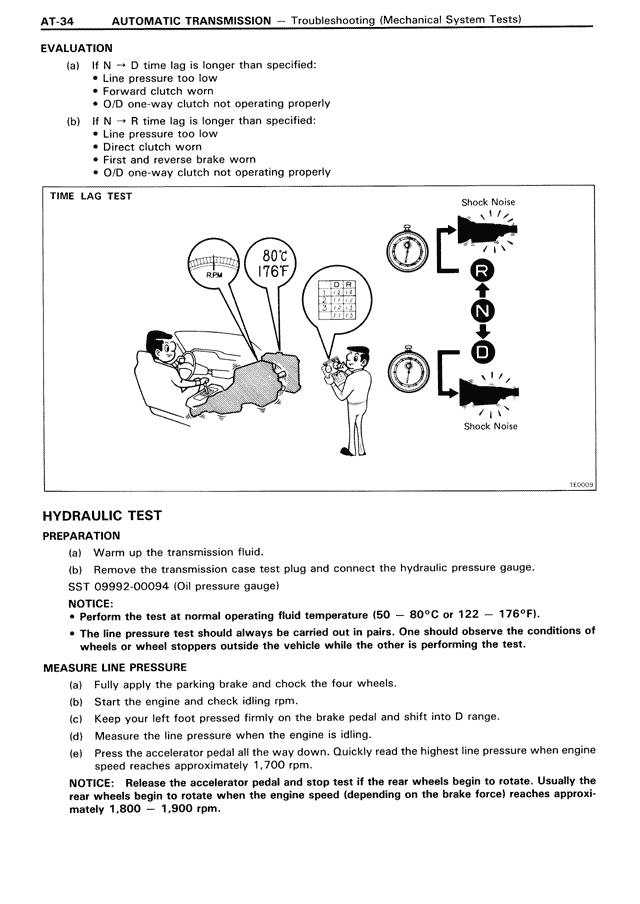
TIME LAG TEST
[Diagram showing test procedure with gauges (RPM and 80°C/176°F), shift pattern, stopwatch, and shock noise indicators for R, N, and D positions]
HYDRAULIC TEST
PREPARATION
(a) Warm up the transmission fluid.
(b) Remove the transmission case test plug and connect the hydraulic pressure gauge.
SST 09992-00094 (Oil pressure gauge)
NOTICE:
• Perform the test at normal operating fluid temperature (50 — 80°C or 122 — 176°F).
• The line pressure test should always be carried out in pairs. One should observe the conditions of wheels or wheel stoppers outside the vehicle while the other is performing the test.
MEASURE LINE PRESSURE
(a) Fully apply the parking brake and chock the four wheels.
(b) Start the engine and check idling rpm.
(c) Keep your left foot pressed firmly on the brake pedal and shift into D range.
(d) Measure the line pressure when the engine is idling.
(e) Press the accelerator pedal all the way down. Quickly read the highest line pressure when engine speed reaches approximately 1,700 rpm.
NOTICE: Release the accelerator pedal and stop test if the rear wheels begin to rotate. Usually the rear wheels begin to rotate when the engine speed (depending on the brake force) reaches approximately 1,500 — 1,900 rpm.