RADIATOR
CLEANING OF RADIATOR
Using water or a steam cleaner, remove any mud and dirt from the radiator core.
NOTICE: If using a high pressure type cleaner, be careful not to deform the fins of the radiator core. If the cleaner water pressure is 30 — 35 kg/cm² (427 — 498 psi, 2,942 — 3,432 ), keep a distance of at least 16 — 50 cm (15.75 — 19.69 in.) from the radiator core and cleaner nozzle.
INSPECTION OF RADIATOR
1. CHECK RADIATOR CAP
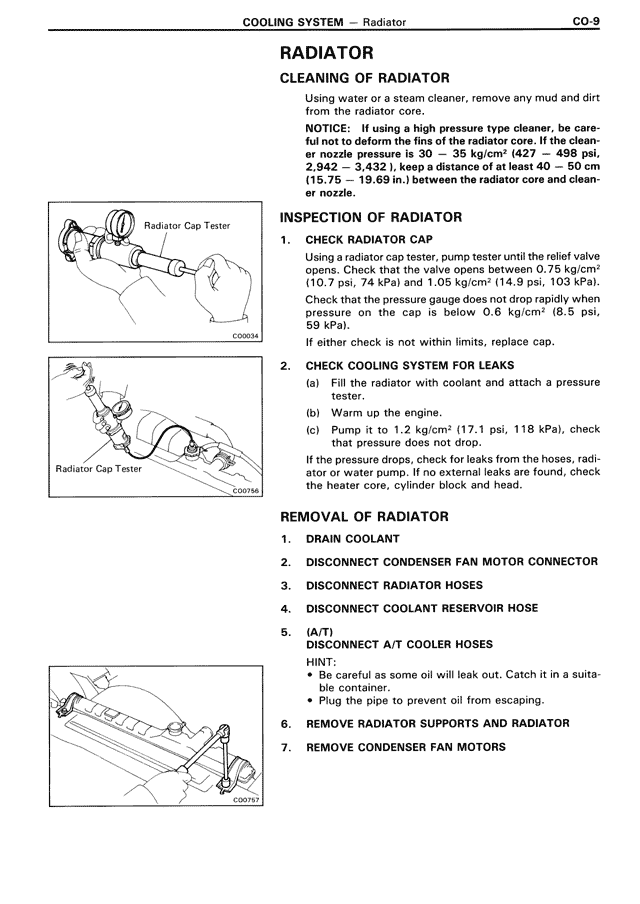
Using a radiator cap tester, pump tester until the relief valve opens. Check that the valve opens between 0.75 kg/cm² (10.7 psi, 74 kPa) and 1.05 kg/cm² (14.9 psi, 103 kPa). Check that the pressure gauge does not drop rapidly when pressure on the cap is below 0.6 kg/cm² (8.5 psi, 59 kPa).
If either check is not within limits, replace cap.
2. CHECK COOLING SYSTEM FOR LEAKS
(a) Fill the radiator with coolant and attach a pressure tester.
(b) Warm up the engine.
(c) Pump it to 1.2 kg/cm² (17.1 psi, 118 kPa), check that pressure does not drop.
If the pressure drops, check for leaks from the hoses, radiator or water pump. If no external leaks are found, check the heater core, cylinder block and head.
REMOVAL OF RADIATOR
1. DRAIN COOLANT
2. DISCONNECT CONDENSER FAN MOTOR CONNECTOR
3. DISCONNECT RADIATOR HOSES
4. DISCONNECT COOLANT RESERVOIR HOSE
5. (A/T)
DISCONNECT A/T COOLER HOSES
HINT:
• Be careful as some oil will leak out. Catch it in a suitable container.
• Plug the pipe to prevent oil from escaping.
6. REMOVE RADIATOR SUPPORTS AND RADIATOR
7. REMOVE CONDENSER FAN MOTORS