4. Check hose and wiring connectors to make sure that they are secure and correct.
5. Non-reusable parts
(a) Always replace cotter pins, gaskets, O-rings and oil seals etc. with new ones.
(b) Non-reusable parts are indicated in the component illustrations by the " ♦ " symbol.
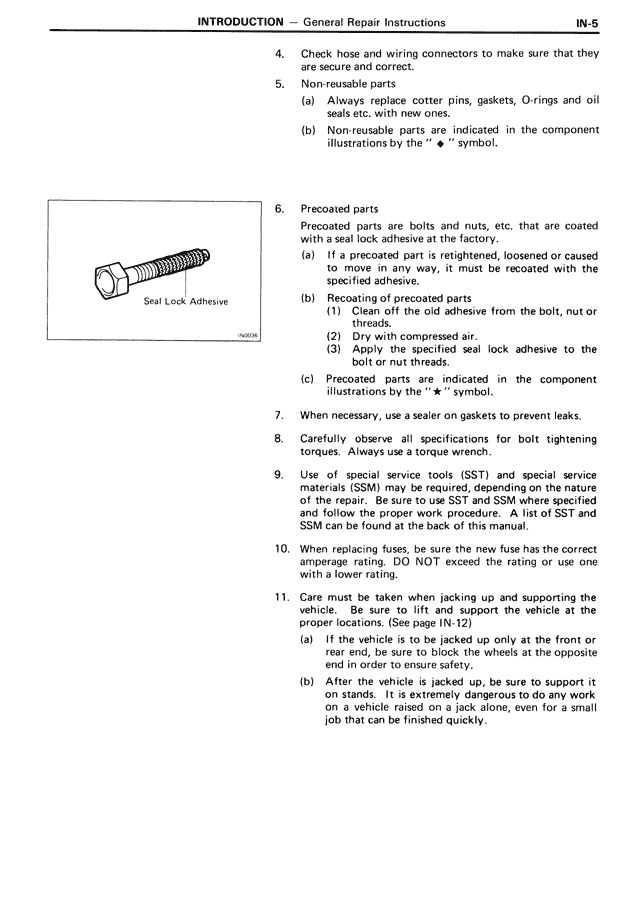
6. Precoated parts
Precoated parts are bolts and nuts, etc. that are coated with a seal lock adhesive at the factory.
(a) If a precoated part is retightened, loosened or caused to move in any way, it must be recoated with the specified adhesive.
(b) Recoating of precoated parts
(1) Clean off the old adhesive from the bolt, nut or threads.
(2) Dry with compressed air.
(3) Apply the specified seal lock adhesive to the bolt or nut threads.
(c) Precoated parts are indicated in the component illustrations by the " ★ " symbol.
7. When necessary, use a sealer on gaskets to prevent leaks.
8. Carefully observe all specifications for bolt tightening torques. Always use a torque wrench.
9. Use the correct special tools. Generally, special service materials (SSM) may be required, depending on the nature of the repair. Be sure to use SST and SSM where required and follow the proper work procedure. A list of SST and SSM can be found at the back of this manual.
10. When replacing fuses, be sure the new fuse has the correct amperage rating. DO NOT exceed the rating or use one with a lower rating.
11. Care must be taken when jacking up and supporting the vehicle. Be sure to lift and support the vehicle at the proper locations. (See page IN-12)
(a) If the vehicle is to be jacked up only at the front or rear end, be sure to block the wheels at the opposite end in order to ensure safety.
(b) After the vehicle is jacked up, be sure to support it on stands. It is extremely dangerous to do any work on a vehicle raised on a jack alone, even for a small job that can be finished quickly.