POWER STEERING
Description
PRINCIPLES OF POWER STEERING
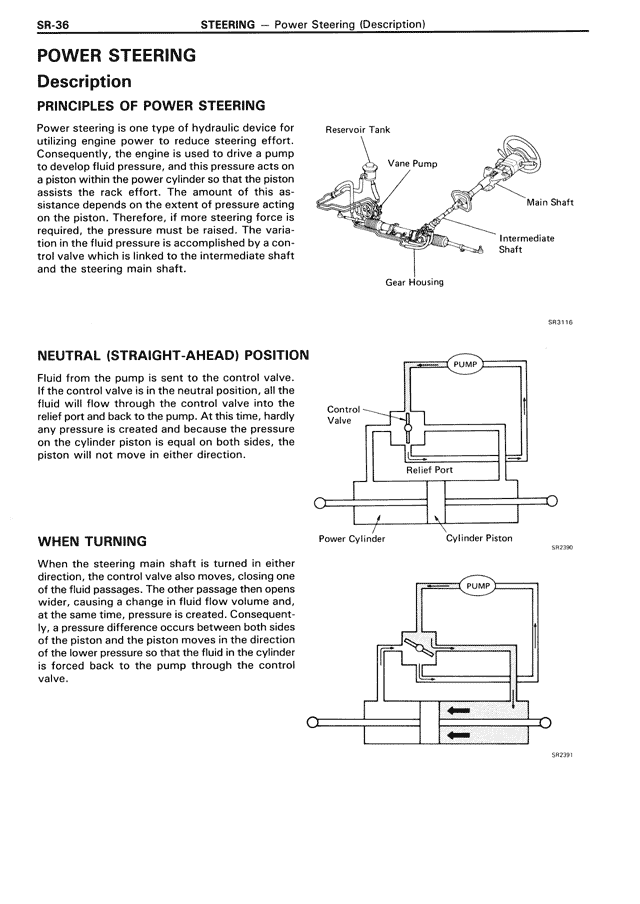
Power steering is one type of hydraulic device for
utilizing engine power to reduce steering effort.
Consequently, the engine is used to drive a pump
to develop fluid pressure. This pressure is used to
a piston within the power cylinder so that the piston
will move by rack effort. The amount of this as-
sistance depends on the extent of pressure acting
on the piston. Therefore, if more steering force is
required, the pressure must be raised. The varia-
tion in the fluid pressure is accomplished by a con-
trol valve which is linked to the intermediate shaft
and the steering main shaft.
Reservoir Tank
Vane Pump
Rack
Main Shaft
Intermediate
Shaft
Gear Housing
SR31/6
NEUTRAL (STRAIGHT-AHEAD) POSITION
Fluid from the pump is sent to the control valve.
If the control valve is in the neutral position, all the
fluid will flow through the control valve into the
reservoir tank back to the pump. At this time, hardly
any pressure is created and because the pressure
on the cylinder piston is equal on both sides, the
piston will not move in either direction.
PUMP
Control
Valve
Relief Port
Power Cylinder
Cylinder Piston
SR7390
WHEN TURNING
When the steering main shaft is turned in either
direction, the control valve also moves, closing one
of the fluid passages. The other passage then opens
wider, causing a change in fluid flow volume and,
at the same time, pressure on the cylinder. Actual-
ly, a pressure difference occurs between both sides
of the cylinder, and the piston moves in the direction
of the lower pressure so that the fluid in the cylinder
is forced back to the pump through the control
valve.
PUMP
SR7391