STEERING — Power Steering (On-Vehicle Inspection) SR-43
OIL PRESSURE CHECK
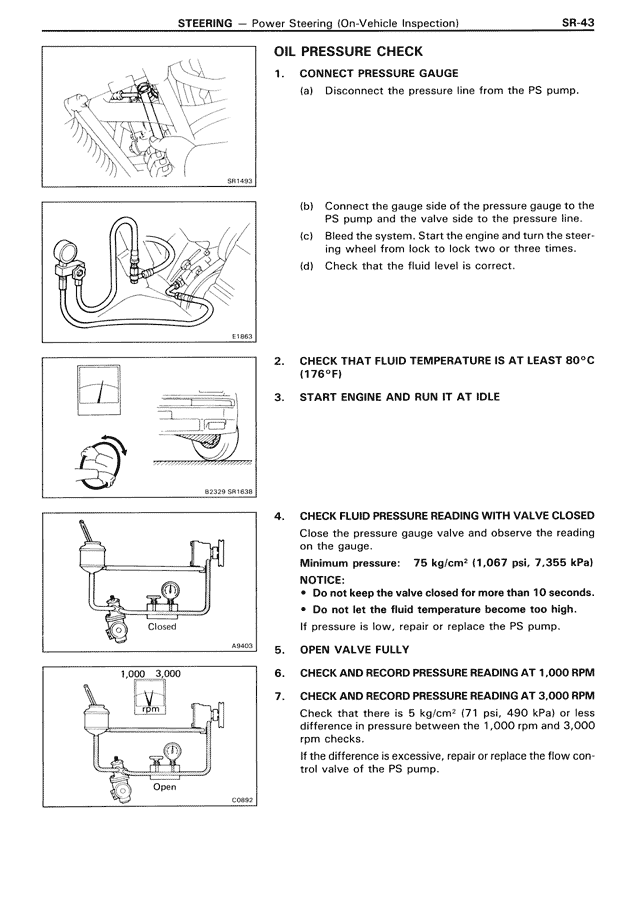
1. CONNECT PRESSURE GAUGE
(a) Disconnect the pressure line from the PS pump.
(b) Connect the gauge side of the pressure gauge to the
PS pump and the valve side to the pressure line.
(c) Bleed the system. Start the engine and turn the steer-
ing wheel from lock to lock two or three times.
(d) Check that the fluid level is correct.
2. CHECK THAT FLUID TEMPERATURE IS AT LEAST 80°C
(176°F)
3. START ENGINE AND RUN IT AT IDLE
4. CHECK FLUID PRESSURE READING WITH VALVE CLOSED
Close the pressure gauge valve and observe the reading
on the gauge.
Minimum pressure: 75 kg/cm² (1,067 psi, 7,355 kPa)
NOTICE:
• Do not keep the valve closed for more than 10 seconds.
• Do not let the fluid temperature become too high.
If pressure is low, repair or replace the PS pump.
5. OPEN VALVE FULLY
6. CHECK AND RECORD PRESSURE READING AT 1,000 RPM
7. CHECK AND RECORD PRESSURE READING AT 3,000 RPM
Check that there is 5 kg/cm² (71 psi, 490 kPa) or less
difference in pressure between the 1,000 rpm and 3,000
rpm checks.
If the difference is excessive, repair or replace the flow con-
trol valve of the PS pump.