SR-44
STEERING — Power Steering (On-Vehicle Inspection)
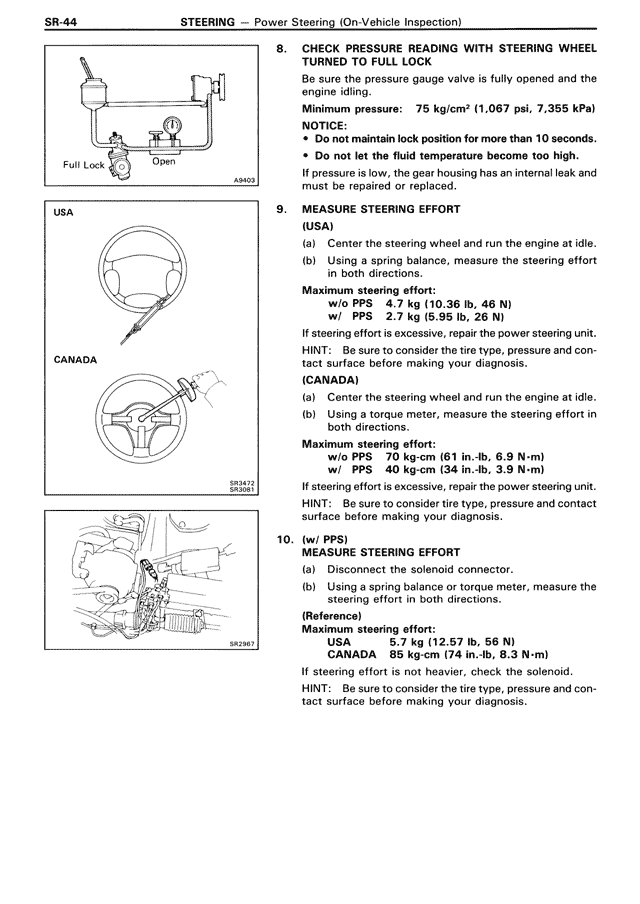
8. CHECK PRESSURE READING WITH STEERING WHEEL TURNED TO FULL LOCK
Be sure the pressure gauge valve is fully opened and the engine idling.
Maximum pressure: 75 kg/cm² (1,067 psi, 7,355 kPa)
NOTICE:
• Do not maintain lock position for more than 10 seconds.
• Do not let the fluid temperature become too high.
If pressure is low, the gear housing has an internal leak and must be repaired or replaced.
9. MEASURE STEERING EFFORT
(USA)
(a) Center the steering wheel and run the engine at idle.
(b) Using a spring balance, measure the steering effort in both directions.
Maximum steering effort:
w/o PPS 4.7 kg (10.36 lb, 46 N)
w/ PPS 2.7 kg (5.95 lb, 26 N)
If steering effort is excessive, repair the power steering unit.
HINT: Be sure to consider the tire type, pressure and contact surface before making your diagnosis.
(CANADA)
(a) Center the steering wheel and run the engine at idle.
(b) Using a torque meter, measure the steering effort in both directions.
Maximum steering effort:
w/o PPS 70 kg-cm (61 in.-lb, 6.9 N·m)
w/ PPS 40 kg-cm (34 in.-lb, 3.9 N·m)
If steering effort is excessive, repair the power steering unit.
HINT: Be sure to consider tire type, pressure and contact surface before making your diagnosis.
10. (w/ PPS)
MEASURE STEERING EFFORT
(a) Disconnect the solenoid connector.
(b) Using a spring balance or torque meter, measure the steering effort in both directions.
(Reference)
Maximum steering effort:
USA 5.7 kg (12.57 lb, 56 N)
CANADA 85 kg-cm (74 in.-lb, 8.3 N·m)
If steering effort is not heavier, check the solenoid.
HINT: Be sure to consider the tire type, pressure and contact surface before making your diagnosis.