Page text (OCR transcript)
AT-8
A340E(Others) AUTOMATIC TRANSMISSION - OPERATION

3. HYDRAULIC CONTROL SYSTEM
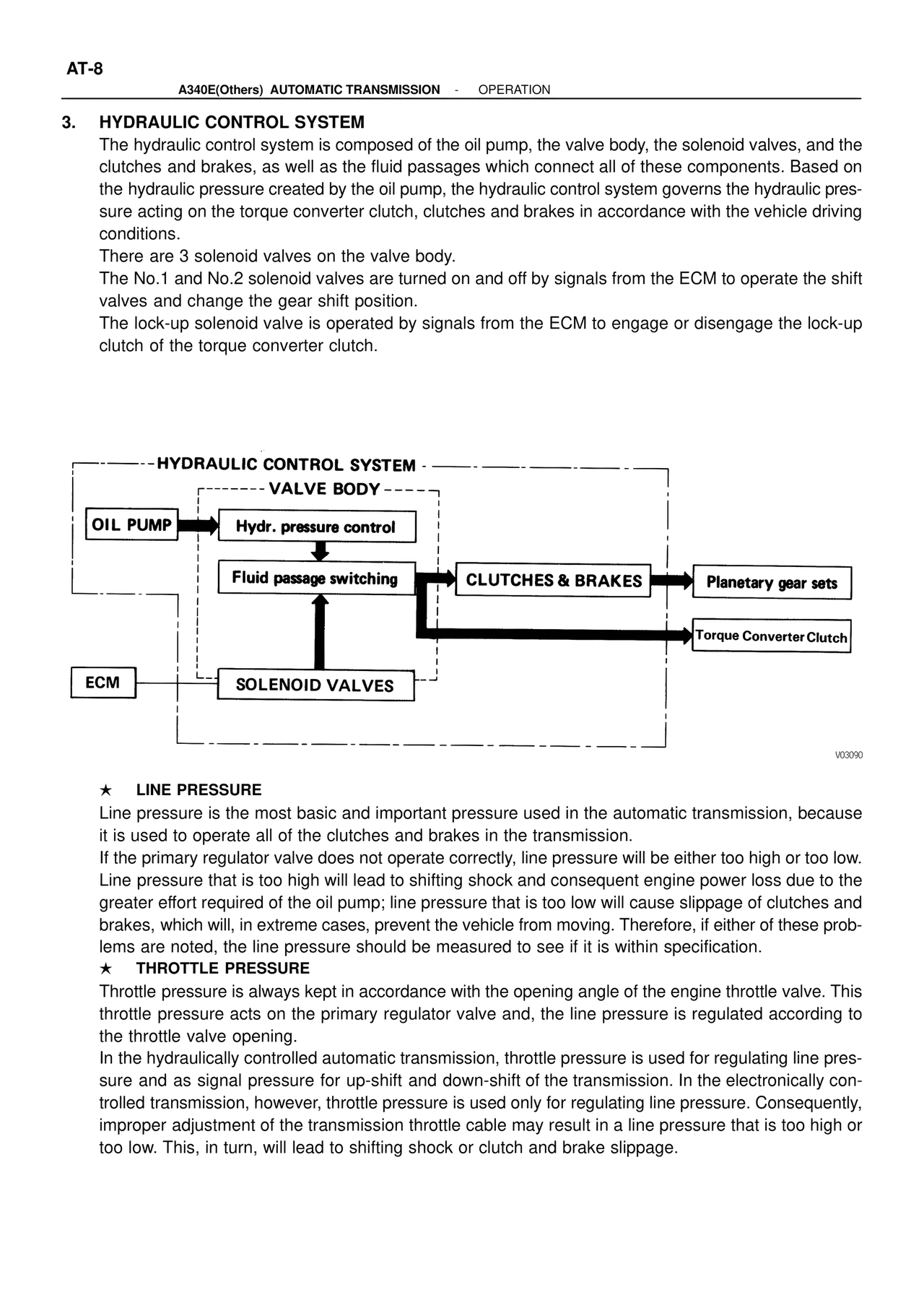
The hydraulic control system is composed of the oil pump, the valve body, the solenoid valves, and the
clutches and brakes, as well as the fluid passages which connect all of these components. Based on
the hydraulic pressure created by the oil pump, the hydraulic control system governs the hydraulic pres-
sure acting on the torque converter clutch, clutches and brakes in accordance with the vehicle driving
conditions.
There are 3 solenoid valves on the valve body.
The No.1 and No.2 solenoid valves are turned on and off by signals from the ECM to operate the shift
valves and change the gear shift position.
The lock-up solenoid valve is operated by signals from the ECM to engage or disengage the lock-up
clutch of the torque converter clutch.

HYDRAULIC CONTROL SYSTEM
VALVE BODY
OIL PUMP → Hydr. pressure control
↓
Fluid passage switching → CLUTCHES & BRAKES → Planetary gear sets
↑                                                              → Torque Converter Clutch
ECM → SOLENOID VALVES

V03090

★ LINE PRESSURE
Line pressure is the most basic and important pressure used in the automatic transmission, because
it is used to operate all of the clutches and brakes in the transmission.
If the primary regulator valve does not operate correctly, line pressure will be either too high or too low.
Line pressure that is too high will lead to shifting shock and consequent engine power loss due to the
greater effort required of the oil pump; line pressure that is too low will cause slippage of clutches and
brakes, which will, in extreme cases, prevent the vehicle from moving. Therefore, if either of these prob-
lems are noted, the line pressure should be measured to see if it is within specification.
★ THROTTLE PRESSURE
Throttle pressure is always kept in accordance with the opening angle of the engine throttle valve. This
throttle pressure acts on the primary regulator valve and, the line pressure is regulated according to
the throttle valve opening.
In the hydraulically controlled automatic transmission, throttle pressure is used for regulating line pres-
sure and as signal pressure for up-shift and down-shift of the transmission. In the electronically con-
trolled transmission, however, throttle pressure is used only for regulating line pressure. Consequently,
improper adjustment of the transmission throttle cable may result in a line pressure that is too high or
too low. This, in turn, will lead to shifting shock or clutch and brake slippage.