EC-14 EMISSION CONTROL SYSTEMS — Exhaust Gas Recirculation (EGR) System (7M-GE)
[Diagram: To Intake Manifold]
6. CHECK EGR VALVE
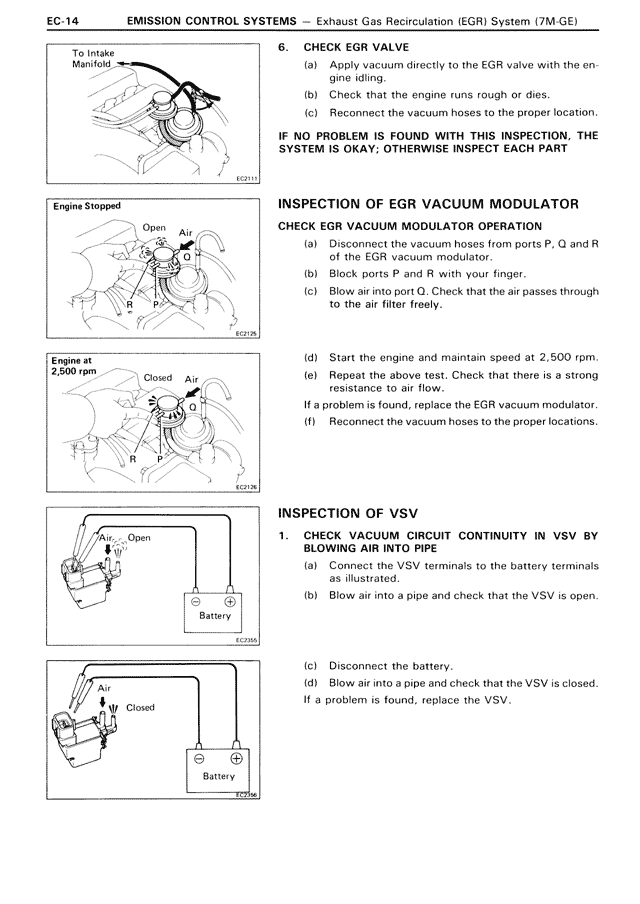
(a) Apply vacuum directly to the EGR valve with the engine idling.
(b) Check that the engine runs rough or dies.
(c) Reconnect the vacuum hoses to the proper location.
IF NO PROBLEM IS FOUND WITH THIS INSPECTION, THE SYSTEM IS OKAY; OTHERWISE INSPECT EACH PART
INSPECTION OF EGR VACUUM MODULATOR
CHECK EGR VACUUM MODULATOR OPERATION
(a) Disconnect the vacuum hoses from ports P, Q and R of the EGR vacuum modulator.
(b) Block ports P and R with your finger.
(c) Blow air into port Q. Check that the air passes through to the air filter freely.
[Diagram: Engine Stopped - Open, Air, P, Q, R]
[Diagram: Engine at 2,500 rpm - Closed, Air, P, Q, R]
(d) Start the engine and maintain speed at 2,500 rpm.
(e) Repeat the above test. Check that there is a strong resistance to air flow.
If a problem is found, replace the EGR vacuum modulator.
(f) Reconnect the vacuum hoses to the proper locations.
INSPECTION OF VSV
1. CHECK VACUUM CIRCUIT CONTINUITY IN VSV BY BLOWING AIR INTO PIPE
(a) Connect the VSV terminals to the battery terminals as illustrated.
(b) Blow air into a pipe and check that the VSV is open.
[Diagram: Air, V, Open, Battery]
(c) Disconnect the battery.
(d) Blow air into a pipe and check that the VSV is closed.
If a problem is found, replace the VSV.
[Diagram: Air, V, Closed, Battery]