EG–398
ENGINE – 2JZ–GE ENGINE TROUBLESHOOTING
FAIL–SAFE CHART
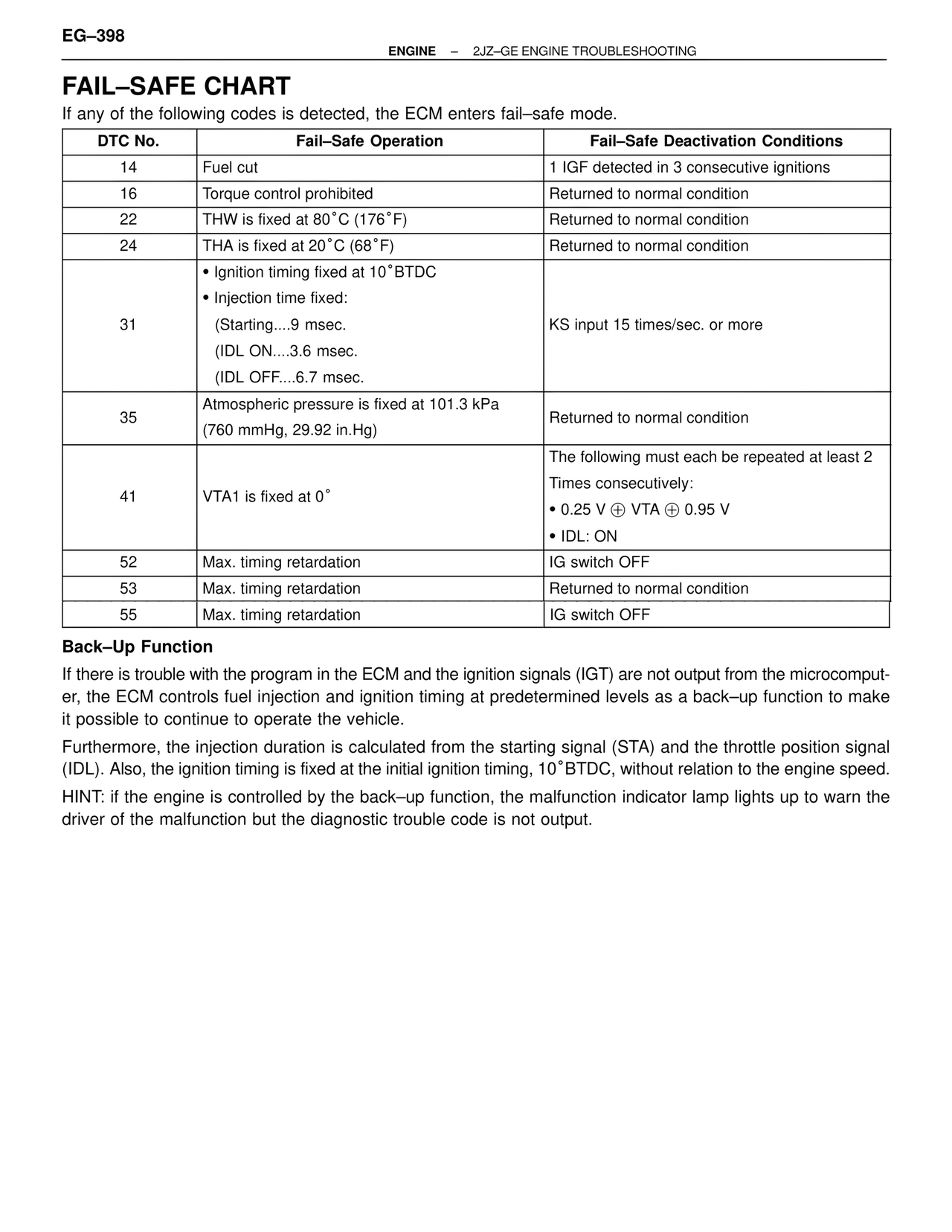
If any of the following codes is detected, the ECM enters fail–safe mode.
DTC No. | Fail–Safe Operation | Fail–Safe Deactivation Conditions
14 | Fuel cut | 1 IGF detected in 3 consecutive ignitions
16 | Torque control prohibited | Returned to normal condition
22 | THW is fixed at 80˚C (176˚F) | Returned to normal condition
24 | THA is fixed at 20˚C (68˚F) | Returned to normal condition
31 | • Ignition timing fixed at 10˚BTDC
• Injection time fixed:
(Starting....9 msec.
(IDL ON....3.6 msec.
(IDL OFF....6.7 msec. | KS input 15 times/sec. or more
35 | Atmospheric pressure is fixed at 101.3 kPa
(760 mmHg, 29.92 in.Hg) | Returned to normal condition
41 | VTA1 is fixed at 0˚ | The following must each be repeated at least 2
Times consecutively:
• 0.25 V ⊕ VTA ⊕ 0.95 V
• IDL: ON
52 | Max. timing retardation | IG switch OFF
53 | Max. timing retardation | Returned to normal condition
55 | Max. timing retardation | IG switch OFF
Back–Up Function
If there is trouble with the program in the ECM and the ignition signals (IGT) are not output from the microcomputer, the ECM controls fuel injection and ignition timing at predetermined levels as a back–up function to make it possible to continue to operate the vehicle.
Furthermore, the injection duration is calculated from the starting signal (STA) and the throttle position signal (IDL). Also, the ignition timing is fixed at the initial ignition timing, 10˚BTDC, without relation to the engine speed.
HINT: if the engine is controlled by the back–up function, the malfunction indicator lamp lights up to warn the driver of the malfunction but the diagnostic trouble code is not output.