EG–564
ENGINE – 2JZ–GTE ENGINE TROUBLESHOOTING
DTC 71 EGR System Malfunction
CIRCUIT DESCRIPTION
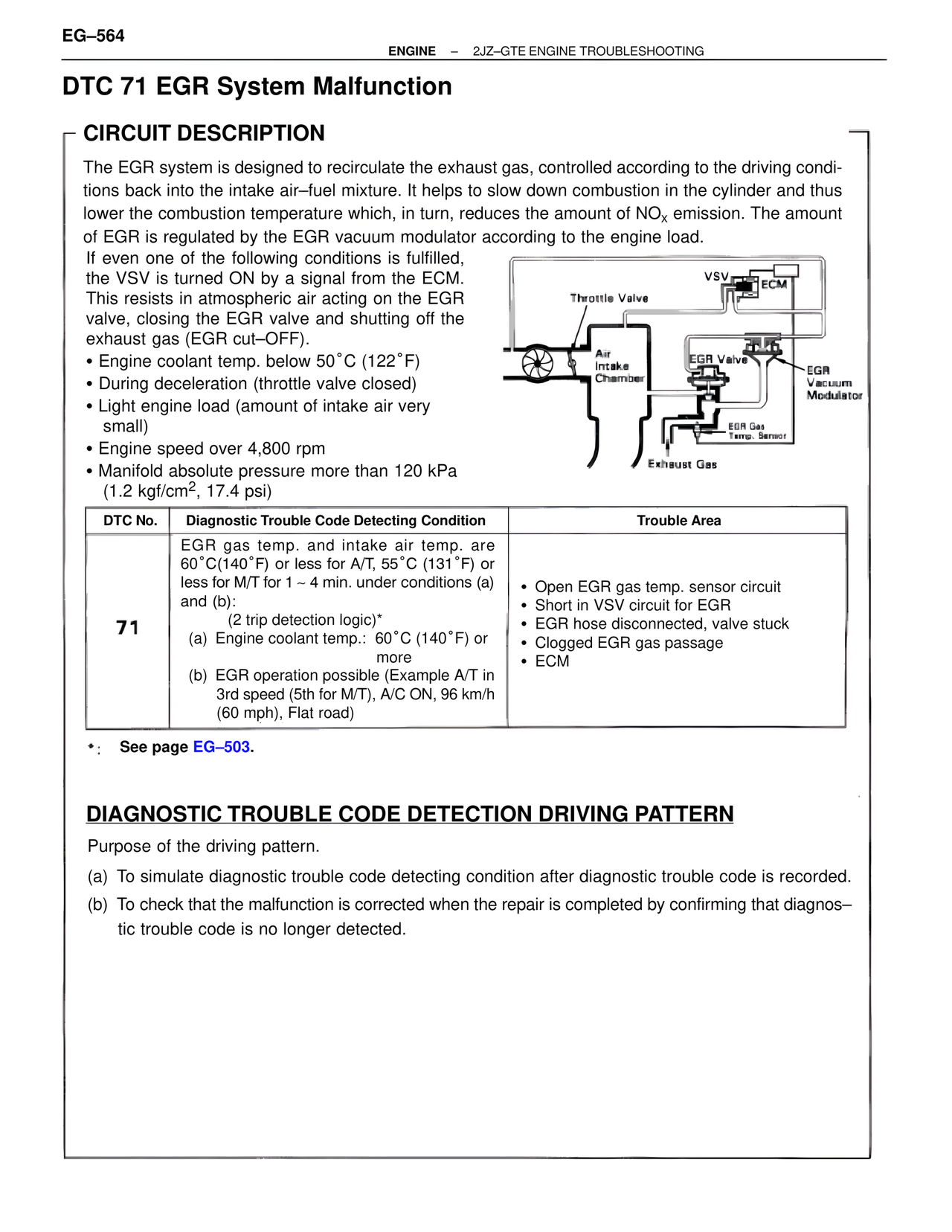
The EGR system is designed to recirculate the exhaust gas, controlled according to the driving conditions back into the intake air–fuel mixture. It helps to slow down combustion in the cylinder and thus lower the combustion temperature which, in turn, reduces the amount of NOx emission. The amount of EGR is regulated by the EGR vacuum modulator according to the engine load.
If even one of the following conditions is fulfilled, the VSV is turned ON by a signal from the ECM. This resists in atmospheric air acting on the EGR valve, closing the EGR valve and shutting off the exhaust gas (EGR cut–OFF).
• Engine coolant temp. below 50°C (122°F)
• During deceleration (throttle valve closed)
• Light engine load (amount of intake air very small)
• Engine speed over 4,800 rpm
• Manifold absolute pressure more than 120 kPa (1.2 kgf/cm2, 17.4 psi)
DTC No. | Diagnostic Trouble Code Detecting Condition | Trouble Area
71 | EGR gas temp. and intake air temp. are 60°C(140°F) or less for A/T, 55°C (131°F) or less for M/T for 1 ~ 4 min. under conditions (a) and (b):
(2 trip detection logic)*
(a) Engine coolant temp.: 60°C (140°F) or more
(b) EGR operation possible (Example A/T in 3rd speed (5th for M/T), A/C ON, 96 km/h (60 mph), Flat road)
| • Open EGR gas temp. sensor circuit
• Short in VSV circuit for EGR
• EGR hose disconnected, valve stuck
• Clogged EGR gas passage
• ECM
*: See page EG–503.
Diagram labels:
VSV
ECM
Throttle Valve
Air Intake Chamber
EGR Valve
EGR Vacuum Modulator
EGR Gas Temp. Sensor
Exhaust Gas
DIAGNOSTIC TROUBLE CODE DETECTION DRIVING PATTERN
Purpose of the driving pattern.
(a) To simulate diagnostic trouble code detecting condition after diagnostic trouble code is recorded.
(b) To check that the malfunction is corrected when the repair is completed by confirming that diagnostic trouble code is no longer detected.