PROBLEM SYMPTOM CONFIRMATION
Taking into consideration the results of the customer problem analysis, try to reproduce the symptoms of the trouble. If the problem is that the transmission does not up–shift, does not down–shift, or the shift point is too high or too low, conduct the following road test to confirm the automatic shift schedule and simulate the problem symptoms.
D Position Full Open
P
R
N
D
2
L
AT2818 000744
ROAD TEST
NOTICE: Do the test at normal A/T fluid operating temp. 50–80°C (122–176°F).
1. D POSITION TEST (NORM PATTERN)
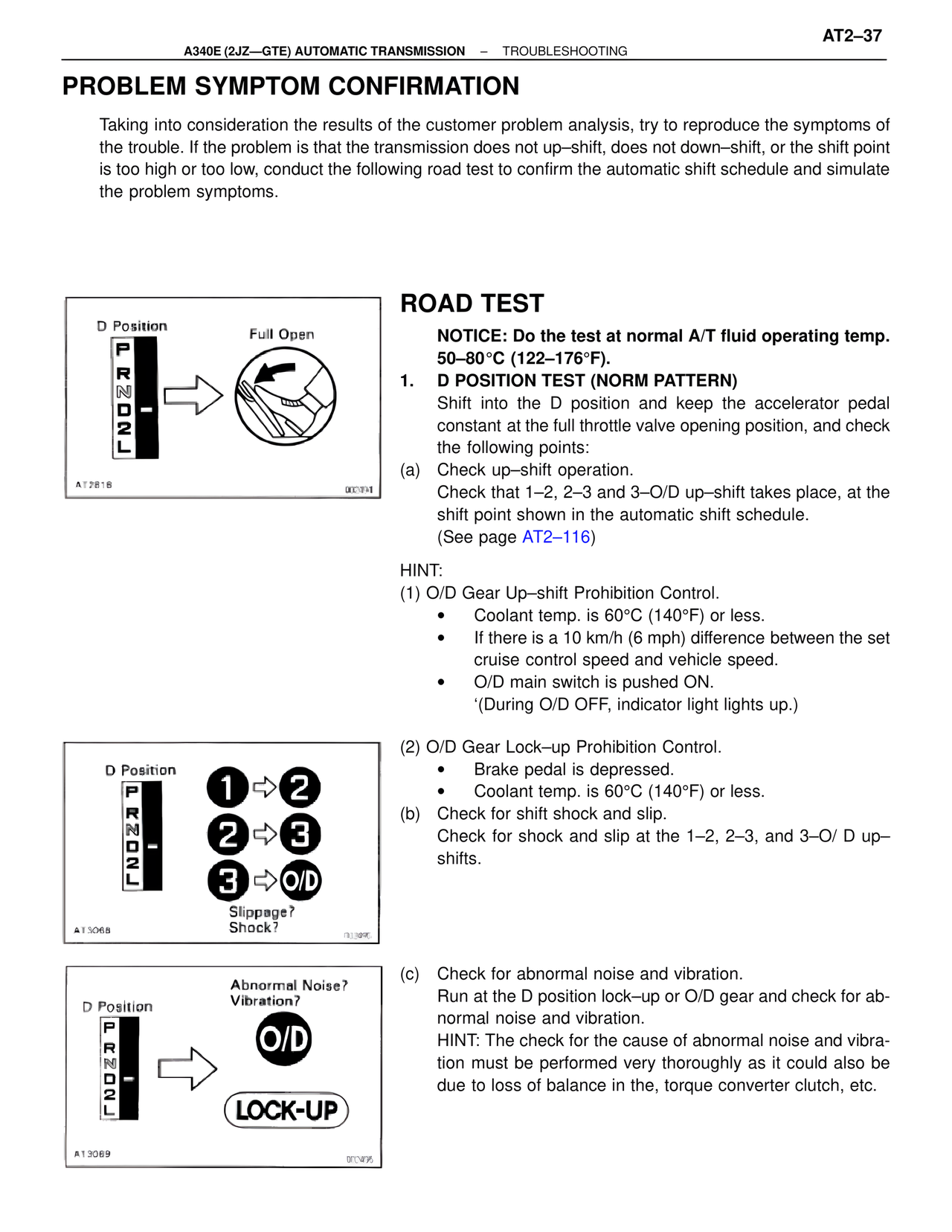
Shift into the D position and keep the accelerator pedal constant at the full throttle valve opening position, and check the following points:
(a) Check up–shift operation.
Check that 1–2, 2–3 and 3–O/D up–shift takes place, at the shift point shown in the automatic shift schedule.
(See page AT2–116)
HINT:
(1) O/D Gear Up–shift Prohibition Control.
• Coolant temp. is 60°C (140°F) or less.
• If there is a 10 km/h (6 mph) difference between the set cruise control speed and vehicle speed.
• O/D main switch is pushed ON.
'(During O/D OFF, indicator light lights up.)
D Position
P
R
N
D
2
L
1 ⇒ 2
2 ⇒ 3
3 ⇒ O/D
Slippage?
Shock?
AT3068 013295
(2) O/D Gear Lock–up Prohibition Control.
• Brake pedal is depressed.
• Coolant temp. is 60°C (140°F) or less.
(b) Check for shift shock and slip.
Check for shock and slip at the 1–2, 2–3, and 3–O/ D up–shifts.
D Position Abnormal Noise?
Vibration?
P
R
N
D
2
L
O/D
LOCK-UP
AT3069 00495
(c) Check for abnormal noise and vibration.
Run at the D position lock–up or O/D gear and check for abnormal noise and vibration.
HINT: The check for the cause of abnormal noise and vibration must be performed very thoroughly as it could also be due to loss of balance in the, torque converter clutch, etc.