EG–9
ENGINE – ENGINE MECHANICAL
COMPRESSION CHECK
HINT: If there is lack of power, excessive oil consumption or
poor fuel economy, measure the compression pressure.
1. WARM UP AND STOP ENGINE
Allow the engine to warm up to normal operating tempera-
ture.
2. 2JZ–GE:
DISCONNECT DISTRIBUTOR CONNECTOR
3. 2JZ–GTE:
DISCONNECT CAMSHAFT POSITION SENSOR CON-
NECTORS
4. 2JZ–GE:
DISCONNECT HIGH–TENSION CORDS FROM SPARK
PLUGS
(See high–tension cords and cord clamps removal in
Ignition System)
5. 2JZ–GTE:
REMOVE IGNITION COILS ASSEMBLIES
(See ignition coils removal in Ignition System)
6. REMOVE SPARK PLUGS
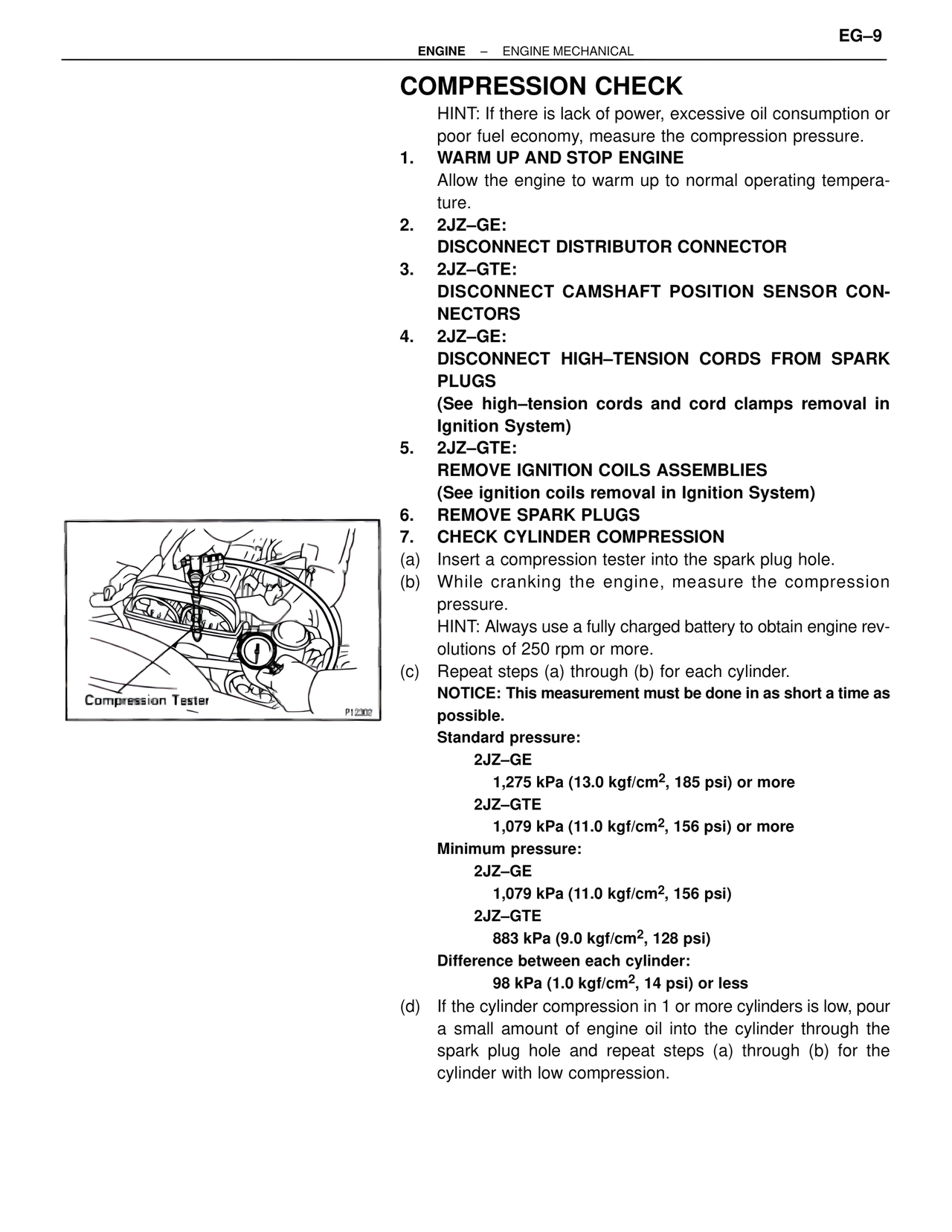
7. CHECK CYLINDER COMPRESSION
(a) Insert a compression tester into the spark plug hole.
(b) While cranking the engine, measure the compression
pressure.
HINT: Always use a fully charged battery to obtain engine rev-
olutions of 250 rpm or more.
(c) Repeat steps (a) through (b) for each cylinder.
NOTICE: This measurement must be done in as short a time as
possible.
Standard pressure:
2JZ–GE
1,275 kPa (13.0 kgf/cm2, 185 psi) or more
2JZ–GTE
1,079 kPa (11.0 kgf/cm2, 156 psi) or more
Minimum pressure:
2JZ–GE
1,079 kPa (11.0 kgf/cm2, 156 psi)
2JZ–GTE
883 kPa (9.0 kgf/cm2, 128 psi)
Difference between each cylinder:
98 kPa (1.0 kgf/cm2, 14 psi) or less
(d) If the cylinder compression in 1 or more cylinders is low, pour
a small amount of engine oil into the cylinder through the
spark plug hole and repeat steps (a) through (b) for the
cylinder with low compression.
Compression Tester
P12302