IN–7
INTRODUCTION – GENERAL REPAIR INSTRUCTIONS
11. Care must be taken when jacking up and supporting the vehicle. Be sure to lift and support the vehicle at the proper locations (See page IN–36).
(a) If the vehicle is to be jacked up only at the front or rear end, be sure to block the wheels at the opposite end in order to ensure safety.
(b) After the vehicle is jacked up, be sure to support it on stands. It is extremely dangerous to do any work on a vehicle raised on a jack alone, even for a small job that can be finished quickly.
12. Observe the following precautions to avoid damage to the following parts:
(a) Do not open the cover or case of the ECU, ECM, PCM or TCM unless absolutely necessary. (If the IC terminals are touched, the IC may be destroyed by static electricity.)
WRONG CORRECT
IN0253
WRONG CORRECT
IN0252
Example
VTV for TP
White Side
VTV for TP
Black Side
IN0002
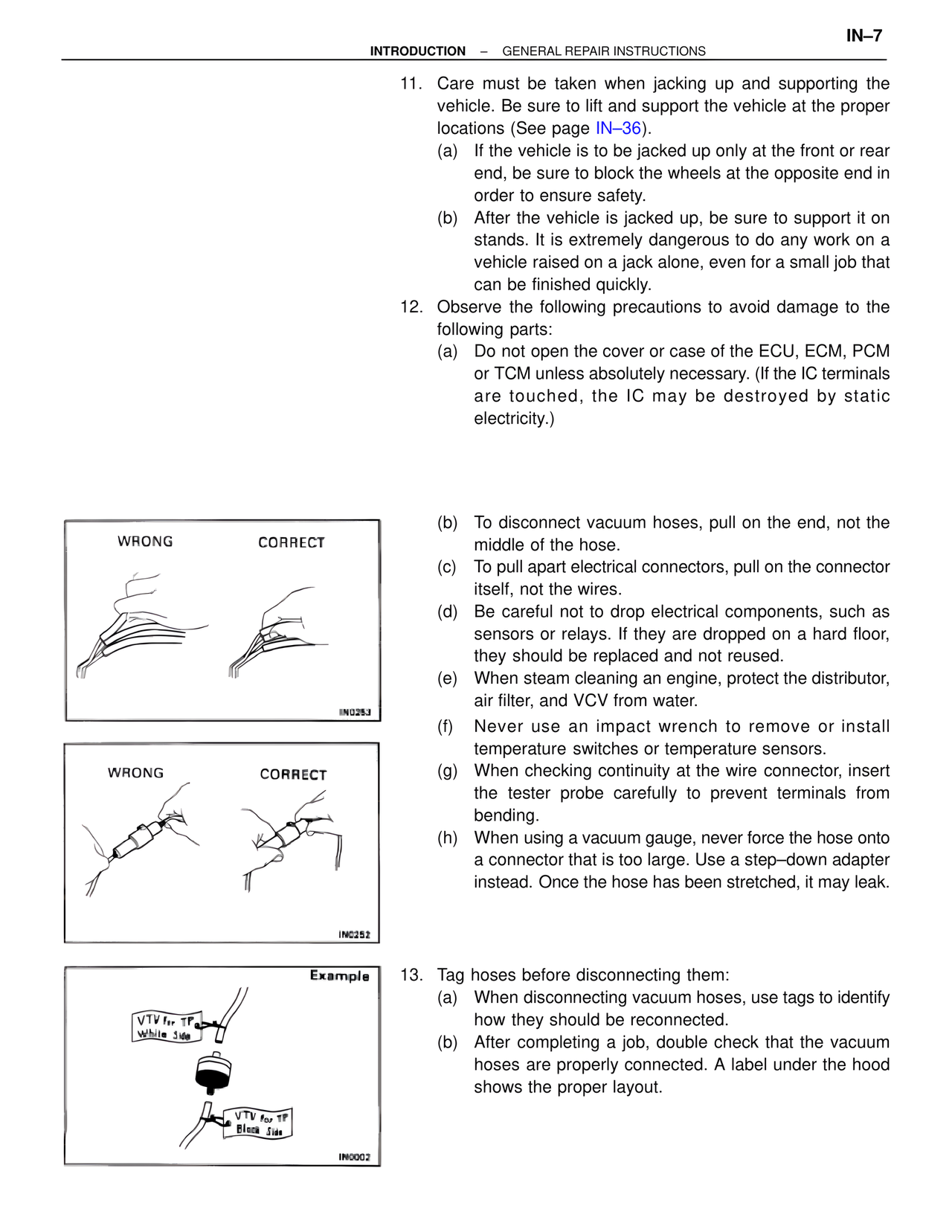
(b) To disconnect vacuum hoses, pull on the end, not the middle of the hose.
(c) To pull apart electrical connectors, pull on the connector itself, not the wires.
(d) Be careful not to drop electrical components, such as sensors or relays. If they are dropped on a hard floor, they should be replaced and not reused.
(e) When steam cleaning an engine, protect the distributor, air filter, and VCV from water.
(f) Never use an impact wrench to remove or install temperature switches or temperature sensors.
(g) When checking continuity at the wire connector, insert the tester probe carefully to prevent terminals from bending.
(h) When using a vacuum gauge, never force the hose onto a connector that is too large. Use a step–down adapter instead. Once the hose has been stretched, it may leak.
13. Tag hoses before disconnecting them:
(a) When disconnecting vacuum hoses, use tags to identify how they should be reconnected.
(b) After completing a job, double check that the vacuum hoses are properly connected. A label under the hood shows the proper layout.