SR–11
STEERING – ON–VEHICLE INSPECTION
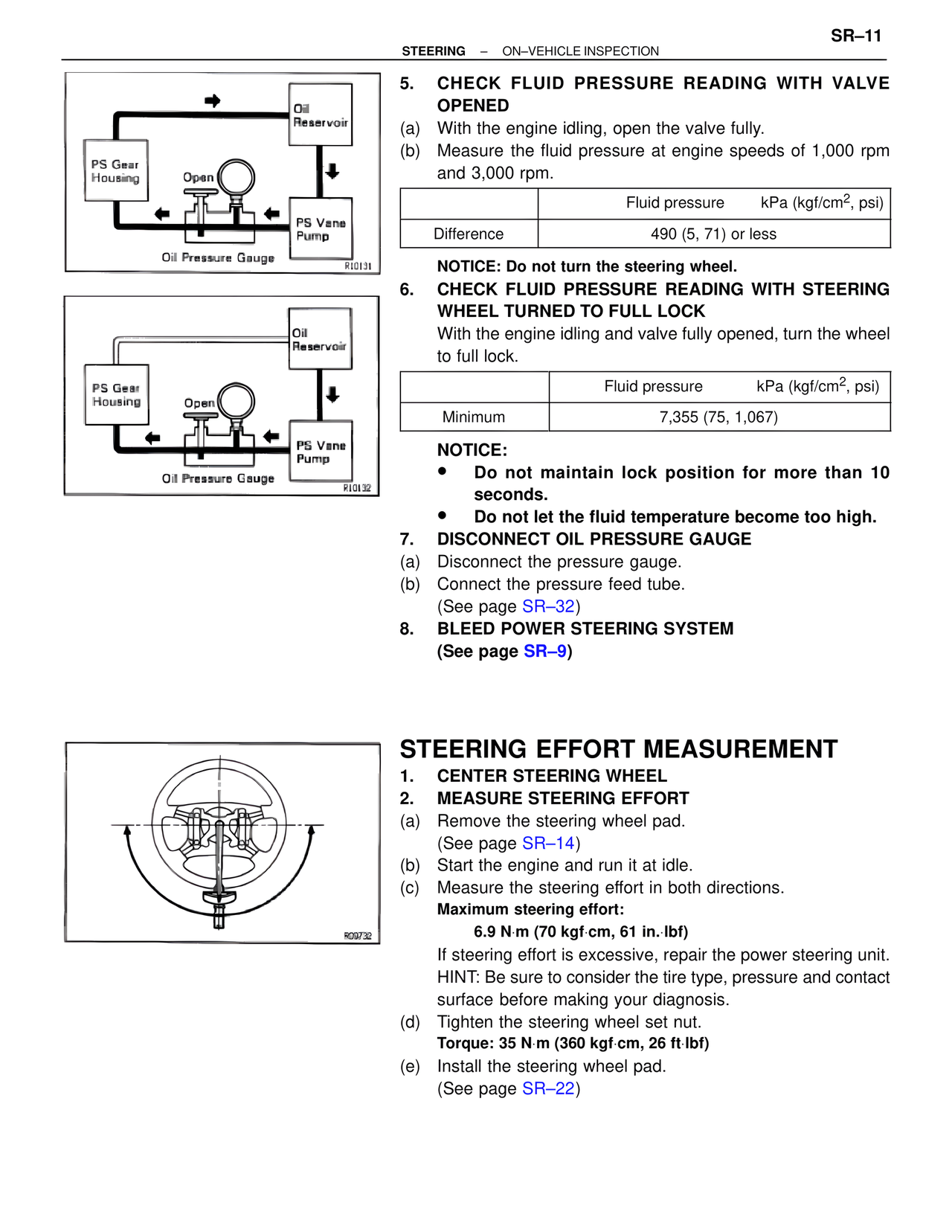
5. CHECK FLUID PRESSURE READING WITH VALVE OPENED
(a) With the engine idling, open the valve fully.
(b) Measure the fluid pressure at engine speeds of 1,000 rpm and 3,000 rpm.
Fluid pressure kPa (kgf/cm², psi)
Difference 490 (5, 71) or less
NOTICE: Do not turn the steering wheel.
6. CHECK FLUID PRESSURE READING WITH STEERING WHEEL TURNED TO FULL LOCK
With the engine idling and valve fully opened, turn the wheel to full lock.
Fluid pressure kPa (kgf/cm², psi)
Minimum 7,355 (75, 1,067)
NOTICE:
• Do not maintain lock position for more than 10 seconds.
• Do not let the fluid temperature become too high.
7. DISCONNECT OIL PRESSURE GAUGE
(a) Disconnect the pressure gauge.
(b) Connect the pressure feed tube.
(See page SR–32)
8. BLEED POWER STEERING SYSTEM
(See page SR–9)
STEERING EFFORT MEASUREMENT
1. CENTER STEERING WHEEL
2. MEASURE STEERING EFFORT
(a) Remove the steering wheel pad.
(See page SR–14)
(b) Start the engine and run it at idle.
(c) Measure the steering effort in both directions.
Maximum steering effort:
6.9 N·m (70 kgf·cm, 61 in.·lbf)
If steering effort is excessive, repair the power steering unit.
HINT: Be sure to consider the tire type, pressure and contact surface before making your diagnosis.
(d) Tighten the steering wheel set nut.
Torque: 35 N·m (360 kgf·cm, 26 ft·lbf)
(e) Install the steering wheel pad.
(See page SR–22)
R10131
R10132
R09732
Oil Reservoir
PS Gear Housing
Open
PS Vane Pump
Oil Pressure Gauge
Oil Reservoir
PS Gear Housing
Open
PS Vane Pump
Oil Pressure Gauge