(g) Reconnect the negative (–) terminal cable to the battery.
(h) Turn the ignition switch ON.
(i) Measure the fuel pressure.
Fuel pressure:
226–275 kPa (2.3–2.8 kgf/cm2, 33–40 psi)
If pressure is high, replace the fuel pressure regulator.
If pressure is low, check the following parts:
• Fuel hoses and connections
• Fuel pump
• Fuel filter
• Fuel pressure regulator
(j) Remove the SST from the DLC1.
SST 09843–18020
(k) Start the engine.
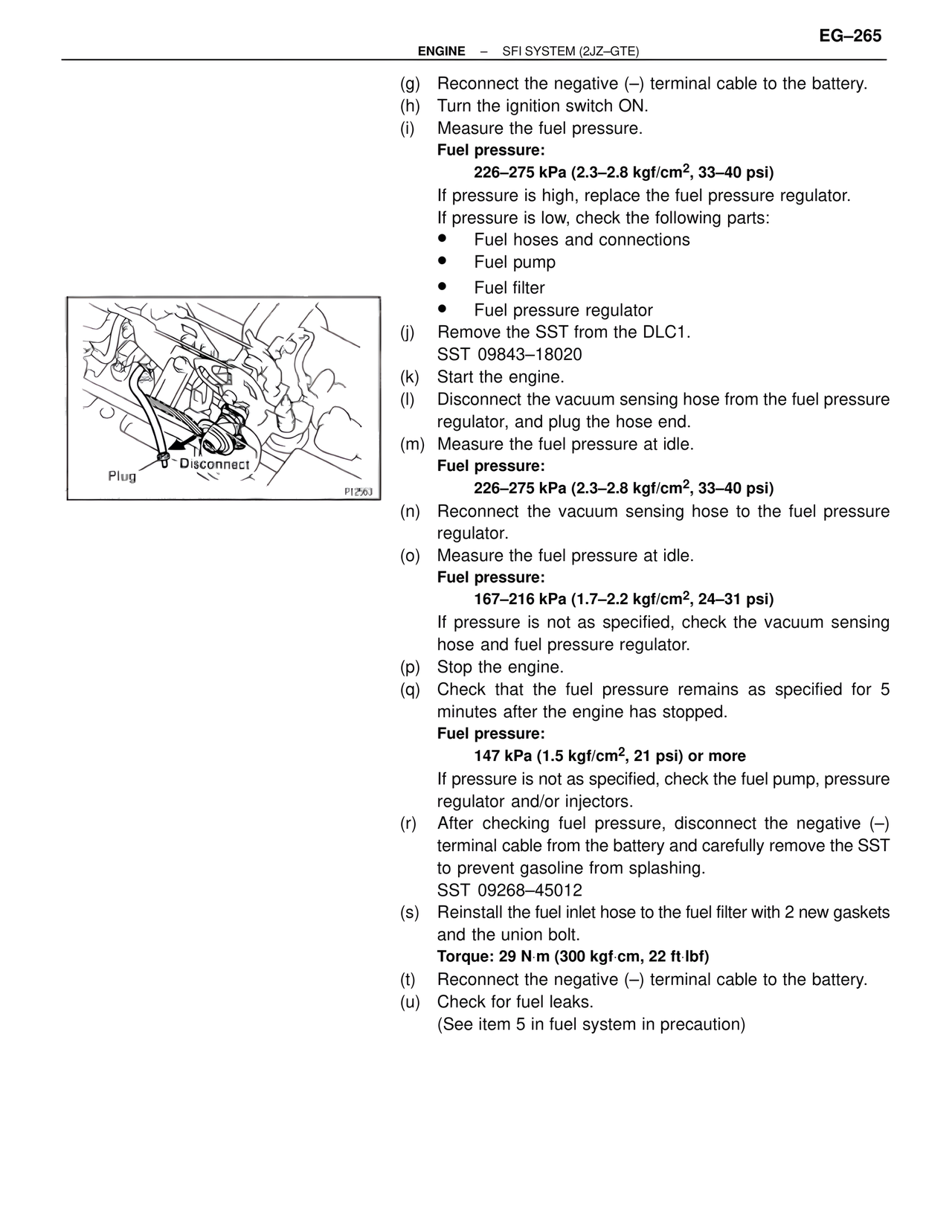
(l) Disconnect the vacuum sensing hose from the fuel pressure regulator, and plug the hose end.
(m) Measure the fuel pressure at idle.
Fuel pressure:
226–275 kPa (2.3–2.8 kgf/cm2, 33–40 psi)
(n) Reconnect the vacuum sensing hose to the fuel pressure regulator.
(o) Measure the fuel pressure at idle.
Fuel pressure:
167–216 kPa (1.7–2.2 kgf/cm2, 24–31 psi)
If pressure is not as specified, check the vacuum sensing hose and fuel pressure regulator.
(p) Stop the engine.
(q) Check that the fuel pressure remains as specified for 5 minutes after the engine has stopped.
Fuel pressure:
147 kPa (1.5 kgf/cm2, 21 psi) or more
If pressure is not as specified, check the fuel pump, pressure regulator and/or injectors.
(r) After checking fuel pressure, disconnect the negative (–) terminal cable from the battery and carefully remove the SST to prevent gasoline from splashing.
SST 09268–45012
(s) Reinstall the fuel inlet hose to the fuel filter with 2 new gaskets and the union bolt.
Torque: 29 N·m (300 kgf·cm, 22 ft·lbf)
(t) Reconnect the negative (–) terminal cable to the battery.
(u) Check for fuel leaks.
(See item 5 in fuel system in precaution)
Plug
Disconnect
PI263